


By Kai Ioh and KE TEAM Hawaii
Kai Ioh is a luxury real estate advisor based in Kona, Hawai‘i, specializing in second home, resort, and ultra-high-net-worth markets across the Big Island.
Key Takeaways
- Hawai‘i still has over 80,000 cesspools, 50,000 or more are located on the Big Island.
- A statewide mandate requires that all cesspools be converted by 2050, making wastewater management a long-term planning issue for property owners.
- The primary barrier has been cost and site constraints.
- House Bill 1618 (2026) introduces financing solutions, including low-interest and potentially forgivable loans.
- For buyers and sellers, cesspools are part of disclosure and sometimes, negotiation.
What Is the Hawaii Cesspool Law and Why Does It Matter in Kona?
In the context of Hawai‘i, wastewater systems are not just a technical detail. They are directly tied to land use, environmental protection, and long-term property value.
Across the Big Island, many homes still rely on cesspools. These systems discharge wastewater directly into the ground without treatment.
This has historically been accepted due to simplicity and low maintenance. However, over time, concerns about groundwater contamination and ocean health have become more prominent.
As a result, Hawai‘i established a statewide requirement:
Act 125 (House Bill 1244), which was signed into law in July 2017, requires all cesspools to be upgraded or converted by 2050. Hawaii had already banned the construction of new cesspools in 2016.
For homeowners and buyers in Kona and the Kohala Coast, this is now part of the real estate conversation.
Why Are There So Many Cesspools on the Big Island?
The prevalence of cesspools in Big Island is largely a function of how the island developed.
Historical Development Patterns
Many neighborhoods were built before modern wastewater infrastructure was widely available. Sewer systems are limited, especially outside denser areas.
Terrain Constraints
Unlike mainland markets, Big Island properties often sit on:
- Lava rock foundations
- Sloped terrain
- Remote or rural lots
These conditions make centralized infrastructure difficult and expensive to install.
Practical Simplicity
Cesspools require minimal maintenance. No pumping. No complex mechanical systems.
For decades, this made them a practical solution.
Why Has Cesspool Conversion Been So Slow?
The issue is not awareness. It is feasibility.
Cost Considerations
Typical conversion costs $20,000 to $30,000, and in some cases significantly more depending on site conditions.
Access Limitations
In Kona, not every property allows easy access for excavation or equipment. Lava rock and steep grading can complicate installation.
Infrastructure Gaps
Sewer connections are not widely available in many parts of the Big Island. This leaves septic systems as the primary alternative, which still require space and engineering. Public or private sewers are very limited, typically serving only downtown and resorts. This means most homes need to install private septic tanks and a leach field.
In practical terms, this is both a financial and logistical challenge.
What Changed in 2026: Understanding HB 1618
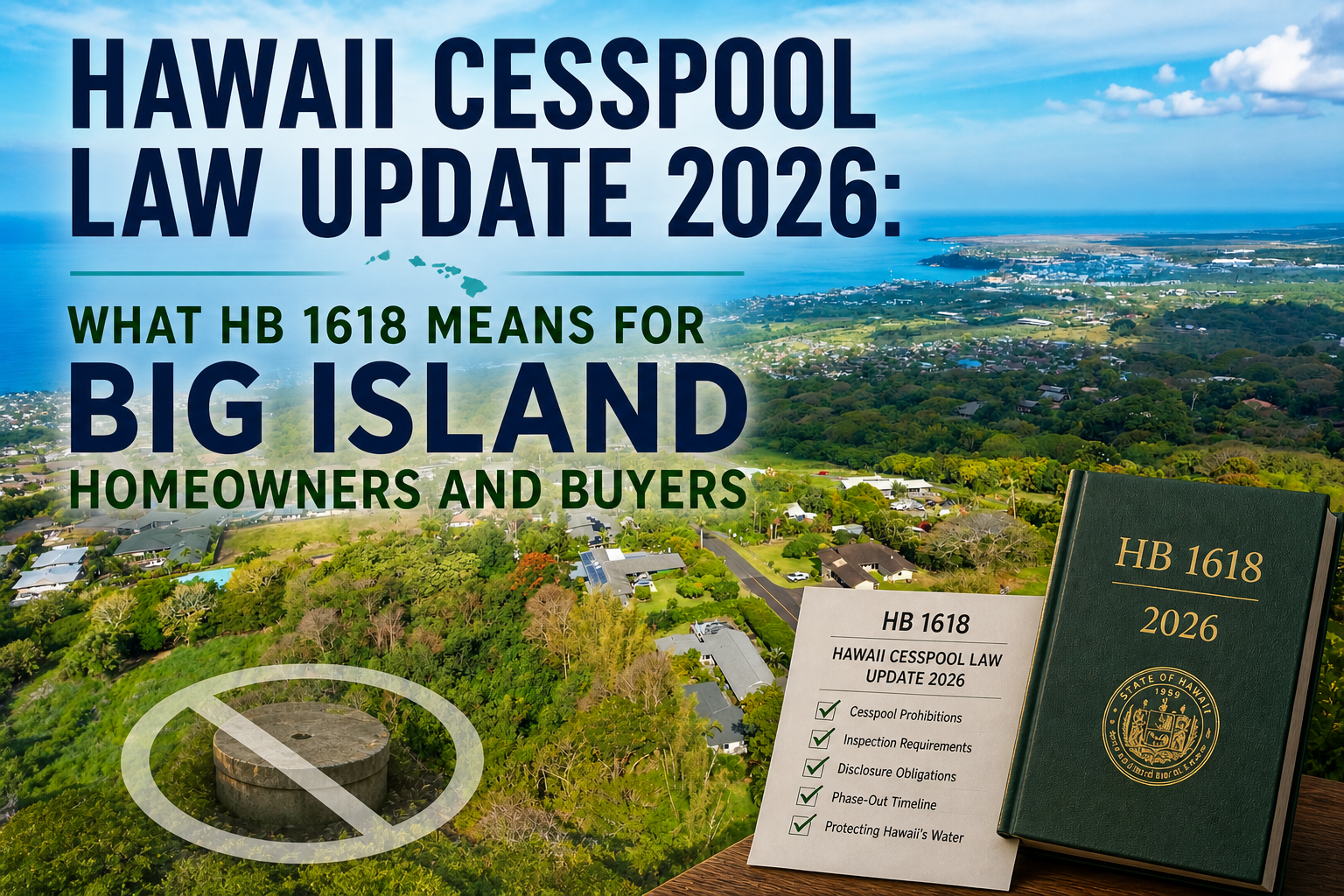
House Bill 1618 represents a shift in Hawai‘i’s approach to cesspool conversion.
Instead of focusing only on mandates, the state is introducing financing mechanisms.
Core Concept
A revolving loan fund, managed by the Hawaii Green Infrastructure Authority, is being developed to support conversions.
Potential Features
- Low-interest loans
- Extended repayment structures
- Possibility of partial loan forgiveness in qualifying cases
This approach acknowledges a key reality:
Without financial support, widespread compliance by 2050 is difficult. HB 1618 is not just a regulation. It is an attempt to make compliance achievable.
How Does This Affect Buyers and Sellers in Kona Real Estate?
As we near 2050, wastewater systems are no longer a background detail from a transaction perspective. Currently, while sellers disclose existing cesspools, this is not yet a point of negotiation.
For Buyers
Many mainland buyers encounter cesspools for the first time in Hawai‘i. The initial reaction is often uncertainty.
Once understood, the concern typically shifts to:
- Future conversion costs
- Timeline expectations
- Property-specific feasibility
However, with no enforcement rules in sight, the cesspool conversion has not evolved into a serious topic yet.
For Sellers
Cesspools are part of required disclosure. In limited cases, they become a point of negotiation. We have dealt with cesspools many times during transactions but not because of 2050 timeline.
What Are the Current Rules and Limitations?
There are important regulatory boundaries that apply today.
Grandfathered Use
Most single-family homes with existing cesspools are allowed to continue operating until the 2050 deadline.
Restrictions on Use
- Multiple units cannot share a single cesspool
- This is referred to as a “gang cesspool” and is not permitted
Enforcement Risk
Violations, particularly involving multi-unit usage, can trigger significant penalties from federal regulators.
Understanding these distinctions is critical when evaluating property use or redevelopment potential.
Big Island Perspective: What We Are Seeing on the Ground
In Kona and surrounding areas, cesspools are present across a wide range of properties, including higher-end homes.
This is not unusual. It reflects how the island evolved.
From experience, most clients are comfortable once they understand:
- How the system works
- What the long-term expectations are
- What options exist for conversion
The uncertainty tends to come from lack of clarity, not from the system itself.
Is This a Sudden Change or a Gradual Transition?
This is best understood as a long-term transition.
The 2050 deadline creates a framework, but the path toward it is still evolving.
Over the past decade, policy discussions have shifted toward:
- Practical implementation
- Financial feasibility
- Environmental balance
HB 1618 is one step in that direction.
More adjustments are likely over time.
Frequently Asked Questions
What is a cesspool and how does it work?
A cesspool is a wastewater system that disposes of untreated sewage directly into the ground. It does not include filtration or treatment components like a septic system.
Why does Hawai‘i want to eliminate cesspools?
Cesspools can impact groundwater and nearshore ocean environments. The goal is to reduce long-term environmental risk.
What is the deadline for cesspool conversion in Hawai‘i?
All cesspools must be converted by 2050 under current state law.
How much does it cost to convert a cesspool in Kona?
Costs often start around $30,000 but can increase depending on terrain, access, and system requirements.
What is HB 1618 in 2026?
HB 1618 proposes a state-supported financing program to help homeowners fund cesspool conversions through loans and possible forgiveness programs.
Are cesspools still allowed when buying a home?
Yes. Many homes are legally operating with cesspools today, especially single-family residences that are grandfathered.
Can multiple units share one cesspool?
No. This is considered a “gang cesspool” and is not allowed under current regulations.
Will buyers avoid homes with cesspools?
Not necessarily. Most buyers proceed once they understand the system and future obligations.
Is sewer connection required instead of septic?
Not always. In many parts of the Big Island, septic systems are the primary upgrade option due to limited sewer infrastructure.
Will the 2050 deadline change?
It is possible that implementation details may evolve, but the current mandate remains in place.