

By Kai Ioh and KE TEAM Hawaii
Kai Ioh is a luxury real estate advisor based in Kona, Hawai‘i, specializing in second home, resort, and ultra-high-net-worth markets across the Big Island.
This Kailua-Kona real estate market update looks at a market that is becoming increasingly segmented. Single-family homes remain relatively balanced, while condominiums continue to favor buyers. At the same time, a sharp national rise in mortgage rates is creating a new affordability test for buyers in Kona and across the Big Island.
The key point is that there is no single “Kona market.” Property type, price range, financing, condition, and location are producing very different outcomes.
Key Takeaways
Kailua-Kona single-family homes remain relatively balanced, with 4.7 months of inventory, while year-to-date sales are slightly ahead of last year.
Condominiums remain in a buyer-favorable market with 8.7 months of supply, although October brought lower inventory and higher pending sales.
Nearly 47% of active Kona homes and condos have experienced a price reduction, making initial pricing increasingly important.
National mortgage rates moved sharply higher entering October. Mortgage News Daily reported an average top-tier 30-year fixed rate of 7.57% on October 2, while Freddie Mac’s weekly average was 7.28% on October 1.
Unlike many mainland markets, Kona includes a significant number of cash, second-home, and luxury buyers. Higher rates still matter, but the effect varies considerably by property type and price range.
The National Housing Backdrop
The national housing environment changed meaningfully during the third quarter.
Bond yields moved sharply higher as stronger economic data and persistent inflation concerns pushed borrowing costs upward. The 10-year U.S. Treasury yield briefly moved above 5.3% entering October, reaching a level not seen in roughly 24 years.
Mortgage rates followed.
Mortgage News Daily’s daily index reached 7.57% on October 2. Freddie Mac’s weekly survey showed 7.28% on October 1, up 25 basis points in one week.
That speed of change matters.
I have often said that buyers can be more sensitive to a rapid change in mortgage rates than to the absolute rate itself. A buyer who has already adjusted expectations around a 7% mortgage may react very differently when rates suddenly rise another half point.
Nationally, we are beginning to see that effect in housing activity.
The weekly national data we are monitoring show:
Approximately 1.13 million homes on the market, 3.8% more than a year ago
Just over 70,000 new pending contracts, 6.1% below last year
Contract cancellations above 13%, the highest level since 2022
Median price per square foot just under $213, slightly below last year
Approximately 42.5% of active listings with a price reduction
The national market entered Q3 with relatively healthy demand growth. That momentum has been gradually weakening as financing costs have climbed.
For Kona, however, the national story is context rather than a direct forecast.
Why the Rate Shock Matters in Kona
Kona does not behave exactly like a typical mainland housing market.
We have more second-home purchasers, more cash transactions, more resort property, and a much wider range of price points. A $700,000 condominium buyer using conventional financing is affected by mortgage rates very differently from a $5 million buyer purchasing primarily with cash.
Still, rates matter.
They influence purchasing power, investor alternatives, buyer psychology, and the cost of carrying a second home. Higher Treasury yields also give affluent buyers more attractive low-risk alternatives for their capital.
In other words, even cash buyers pay attention to interest rates.
The practical effect is a more selective buyer. And we can see some of that selectivity in the Kona numbers.
Kailua-Kona Single-Family Homes Remain Relatively Balanced
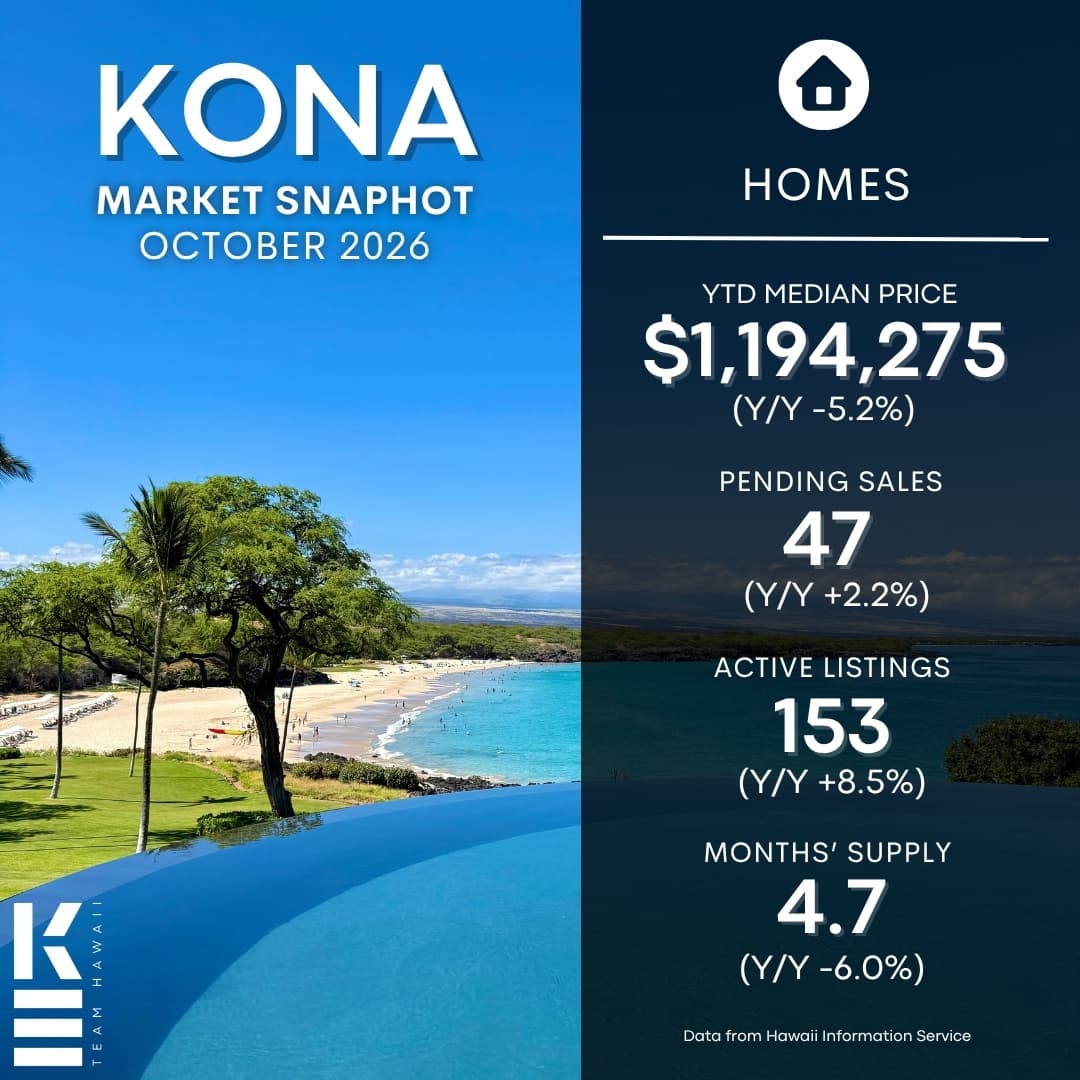
The year-to-date median price for a Kailua-Kona single-family home is $1,194,275, down 5.2% year over year. Pricing has essentially returned to approximately 2023 levels following the significant appreciation of the past several years.
There are some encouraging short-term signals.
Median price increased slightly from the previous month, while median sold price per square foot moved to $681. That is still 6.2% below last year, but the month-to-month movement was positive.
Transaction volume has also held up reasonably well.
A total of 284 single-family homes have closed year to date, up 2.2% from the same period last year.
Supply and Demand
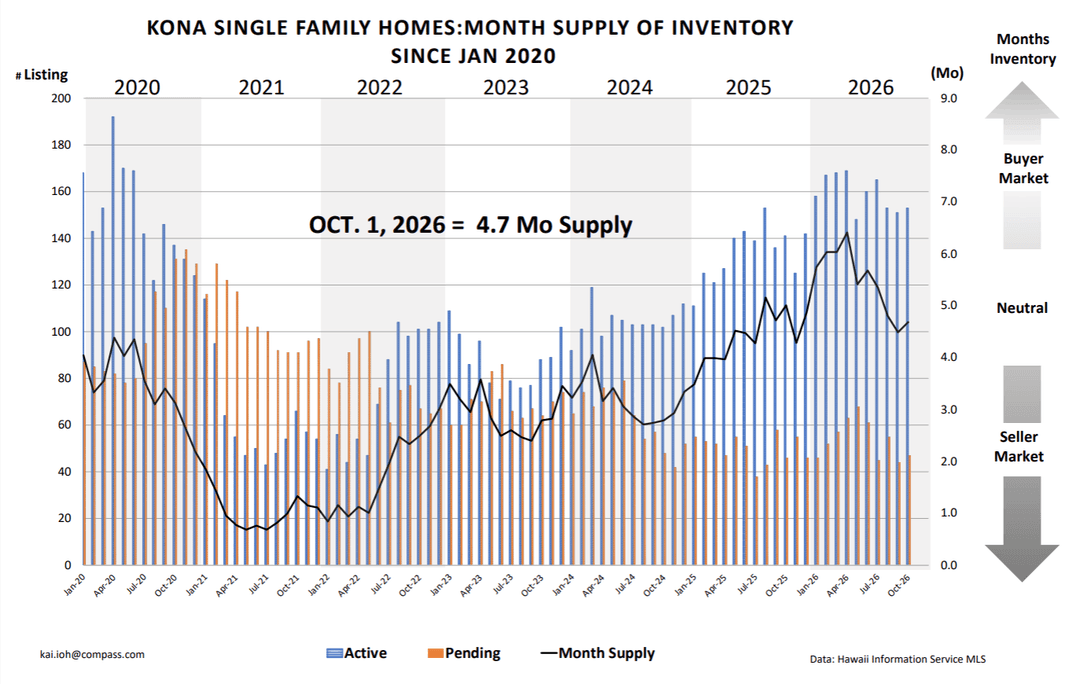
Active inventory moved only slightly, from 151 homes on September 1 to 153 on October 1.
At the same time, pending sales increased from 44 to 47.
Kona currently has approximately 4.7 months of single-family home inventory, down 6% from last year. I generally view four to six months of inventory as relatively neutral, meaning the market does not clearly favor either buyers or sellers.
But “balanced” does not mean every property is selling easily.
Median days on market(DOM) have climbed to 37 days, up 32.1% year over year.
Buyers have choices. They are comparing condition, location, insurance, monthly ownership costs, and pricing more carefully than they did during the unusually competitive market of several years ago.
Price Reductions Tell an Important Story
This is one of the more useful numbers in the October data.
Of the 153 active single-family homes, 72 have experienced a price reduction. That is approximately 47%.
Among the 47 pending homes, only 12 had a price reduction, or approximately 26%.
That difference is meaningful.
It does not mean that every property should be priced aggressively below market. It does suggest that homes entering the market at a price buyers recognize as reasonable are more likely to generate activity before needing an adjustment.
Nationally, roughly 42.5% of available homes in the weekly data have had their prices cut. Kona is slightly above that level.
For sellers, initial positioning matters more than it did when inventory was scarce.
There is an old temptation to “test the market” and adjust later. In the current environment, that approach deserves more careful thought.
Price Range Matters More Than the Overall Median
Broad market statistics can be misleading because individual price ranges behave very differently.
$800,000 to $999,999
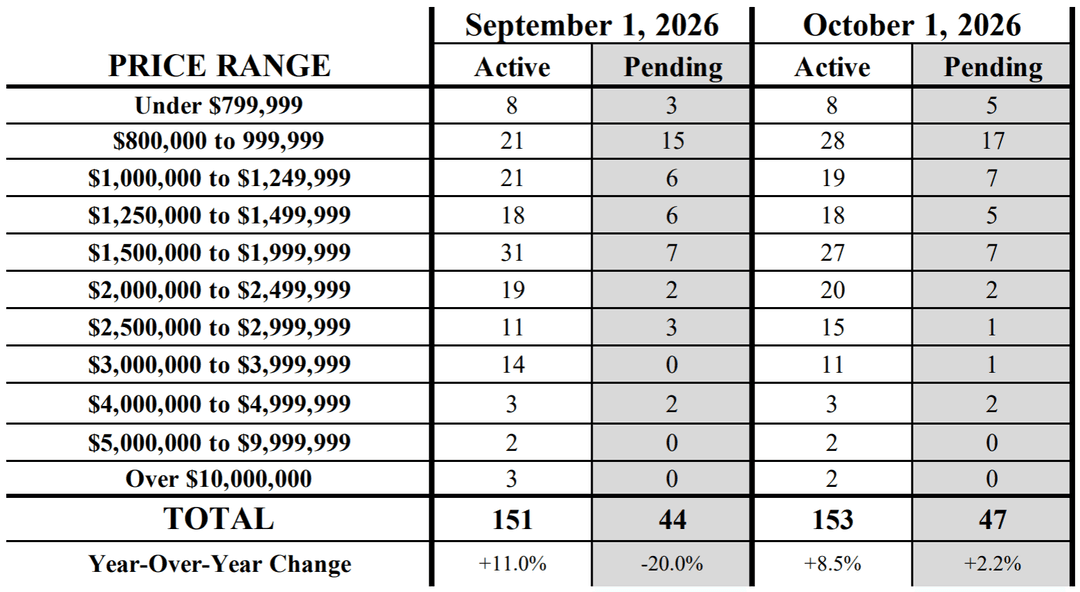
This remains one of the more active portions of the single-family market. Active inventory increased from 21 to 28 homes, while pending sales increased from 15 to 17. There is more competition than a month ago, but buyer activity remains relatively healthy.
$2 Million to $2.999 Million
The picture changes significantly in this range.
There are currently 35 active homes and only 3 pending sales, for a 12-to-1 active-to-pending ratio. That is a very different market from the sub-$1 million segment. For sellers in this range, the competing inventory matters enormously. Buyers have enough choice to be patient.
$4 Million to $5 Million
Then the market changes again.
There are only three active homes and two pending sales in this segment. Both pending properties are represented by our team. It is a useful reminder that a higher price does not automatically mean weaker demand.
Some luxury niches have limited supply and a very specific buyer pool. In Kona luxury real estate, looking at the exact competitive set is often more useful than relying on the overall median.
Kailua-Kona Condos Remain Buyer-Favorable
The condominium market remains softer than the single-family market, although October brought some improvement.
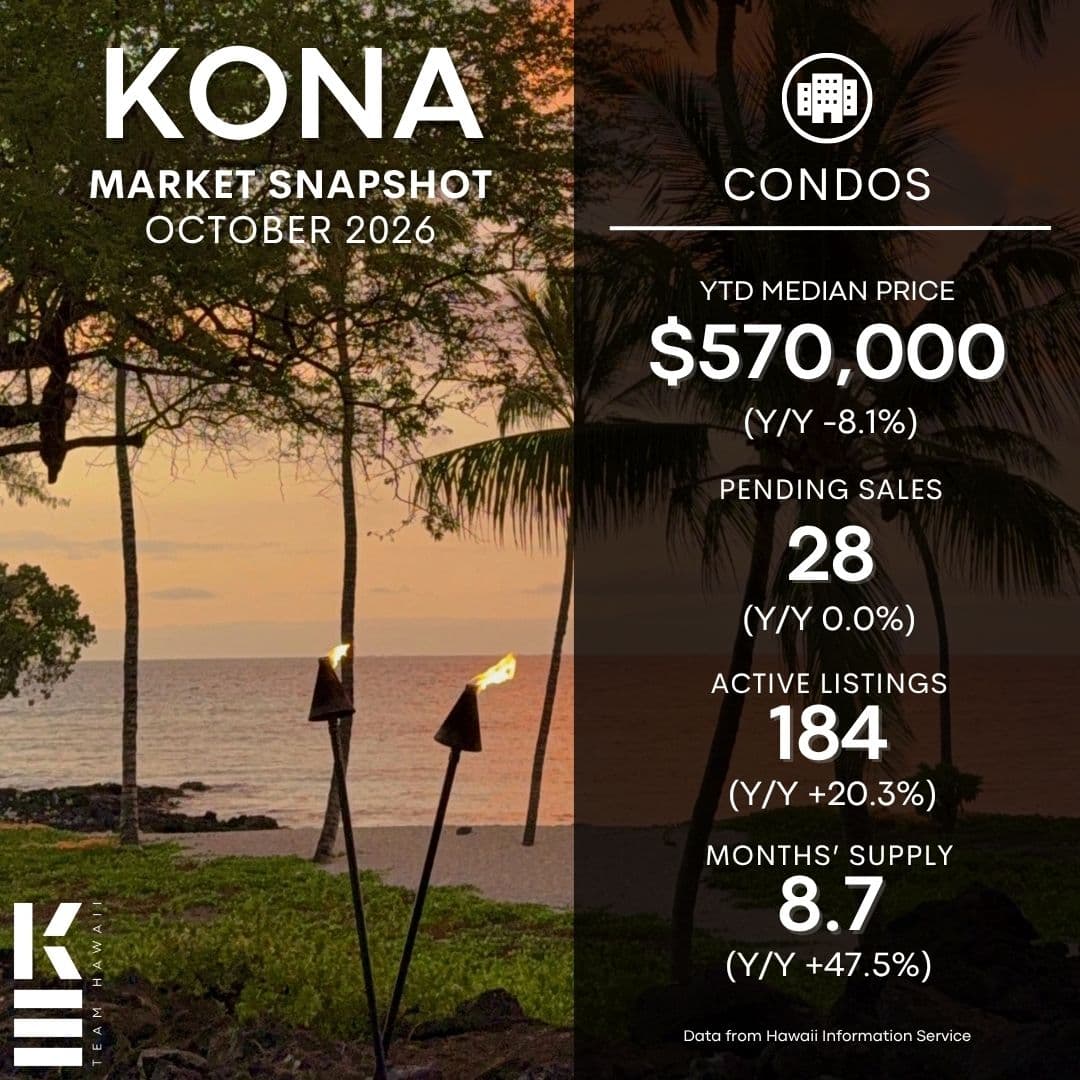
The year-to-date median condominium price is now $570,000, down 8.1% year over year.
Median sold price per square foot has been more stable at $630, compared with $628 last month, although it remains 4.7% below last year. Transaction volume has also declined.
A total of 200 condos have closed year to date, down 17% from last year.
Those numbers continue to indicate a softer condominium market than we are seeing with single-family homes.
October Brought a Better Supply-and-Demand Mix
Active condo listings declined from 197 to 184, a decrease of approximately 6.6% in one month.
At the same time, pending sales increased from 24 to 28, approximately a 17% increase.
Lower inventory combined with higher pending activity is encouraging. One month does not establish a trend, particularly in a relatively small market like Kona. But this is a number worth watching.
Buyers Still Have Meaningful Leverage in Condos
Kailua-Kona currently has approximately 8.7 months of condo inventory, up 47.5% from last year. That is well above the four-to-six-month range I generally consider balanced.
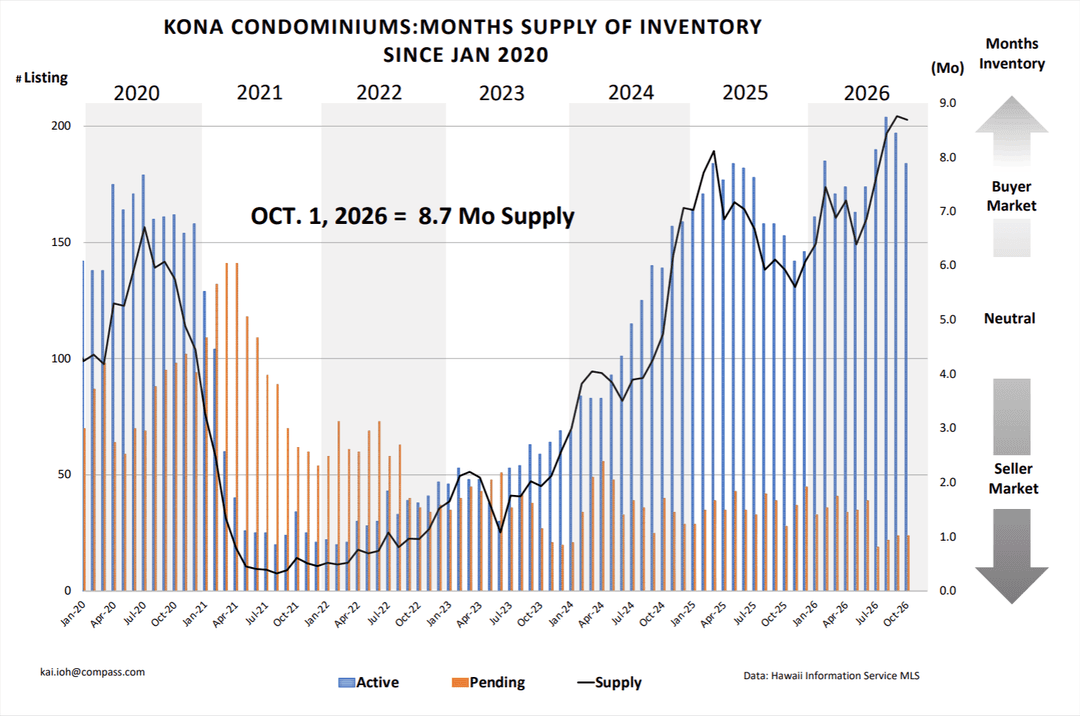
Interestingly, median days on market is 51 days, down 3.8% year over year.
That combination tells us something useful: buyers have considerably more inventory to choose from, but they are still acting when they find a property they consider appropriately priced and attractive.
More inventory does not necessarily mean nobody is buying. It means buyers can be more selective.
Condo Demand Varies by Price Range
The $500,000 to $750,000 range appears to be one of the healthier portions of the condo market.
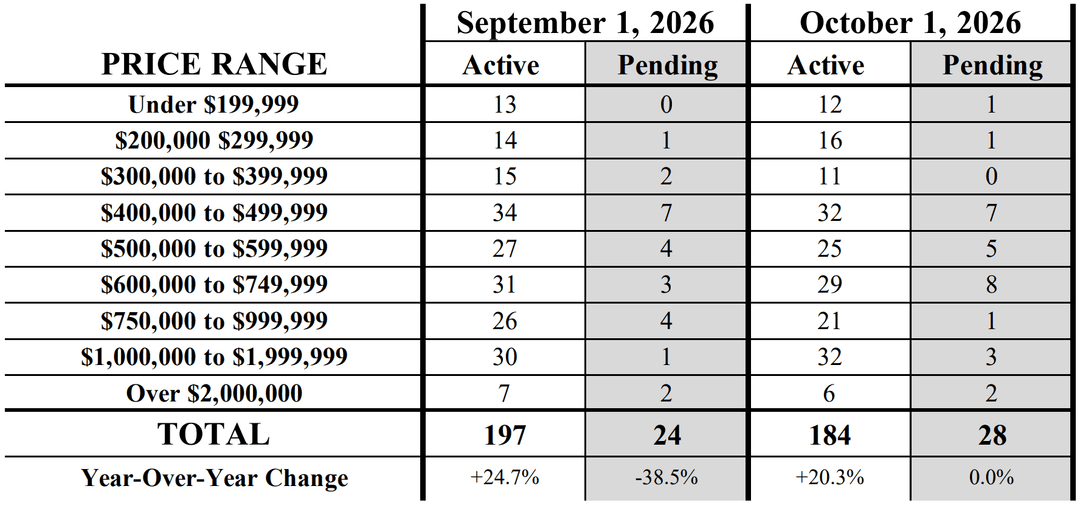
Between $500,000 and $599,999, there are 25 active condos and five pending. Between $600,000 and $749,999, there are 29 active condos and eight pending.
The situation differs between $1 million and $2 million: there are 32 active listings and only 3 pending sales. That is more than a 10-to-1 active-to-pending ratio.
Again, saying simply that “the Kona condo market is down” misses much of the useful information.
Condo Price Reductions Remain Widespread
Of the 184 active condos, 86, or approximately 47%, have experienced a price reduction.
Among the 28 pending condos, 13, or approximately 46%, have also had reductions.
That pattern is quite different from single-family homes.
For houses, the percentage of price-reduced listings drops substantially when we compare active inventory with pending properties.
For condos, the reduction rate is almost identical.
This suggests that price discovery is still taking place throughout the condo market. A price adjustment is not necessarily preventing a condo from selling. In many cases, it may be part of what eventually brings the property into alignment with current buyer expectations.
Financing Is Becoming More Important in the Condo Market
Financing deserves special attention in the condominium market. Conventional lending guidelines can vary by project, and issues involving insurance, reserves, owner occupancy, litigation, deferred maintenance, or association documentation may affect financing eligibility. That matters even for sellers hoping to attract cash buyers.
If financing becomes difficult in a particular project, the eligible buyer pool becomes smaller. A smaller buyer pool can affect both market time and pricing.
For condo buyers, understanding the building can therefore be just as important as understanding the unit. Please check out our latest blog regarding condo financing here.
Higher Mortgage Rates Are Changing Buyer Calculations
The recent move in rates changes the calculation for financed buyers.
On a national median-priced home near $400,000 with 10% down, principal and interest payments are now approaching the highs seen when mortgage rates last moved into the mid-7% range.
Kona prices are considerably higher than the national median, so the dollar impact can be more substantial.
But Kona also has a larger percentage of second-home and cash purchasers than many mainland markets. That means the effect of mortgage rates is uneven.
For a financed condo buyer, rates may directly determine purchasing power.
For a cash luxury buyer, rates may instead affect investment allocation, negotiating behavior, or the perceived opportunity cost of holding real estate.
Both buyers are responding to rates, just in different ways.
What the Current Market Means for Kona Buyers
For buyers, this is a market where patience and careful property selection can be useful.
Condo buyers in particular have meaningful inventory and negotiating leverage. Several single-family price ranges also provide considerably more choice than during the low-inventory years.
But I would not assume that every seller is equally motivated.
Well-located homes in good condition can still attract buyers quickly when the price makes sense. Certain luxury niches also remain surprisingly tight.
The most useful approach is to look at inventory and pending activity within the specific property type and price range you are considering.
That usually tells us far more than a broad market label.
What the Current Market Means for Kona Sellers
For sellers, October reinforces the importance of preparation and pricing.
Nearly half of active homes and condos have experienced a price reduction.
The single-family numbers are particularly interesting: approximately 47% of active homes have reduced their price, compared with only 26% of pending homes.
That does not mean a reduction should never be used. Markets change, and sometimes repositioning is appropriate. But the data suggest there is value in understanding the competition carefully before the property goes live.
In this environment, buyers notice the difference between a property that is well positioned and one that is simply testing a higher number.
National Weakness Does Not Translate Directly to Kona
National housing demand weakened during the third quarter as borrowing costs rose. Mortgage applications have also declined as rates moved higher.
At the same time, two important supports remain: employment has been relatively stable and U.S. equity markets have remained resilient.
Those factors matter in Hawai‘i luxury real estate.
Many Kona and Kohala Coast purchasers derive their buying power not only from salary, but also from equities, business ownership, investment portfolios, and accumulated wealth. That is one reason a luxury resort market can behave differently from a mortgage-dependent mainland suburb.
It does not make Kona immune. It simply means we need to watch the right indicators.
The Bottom Line: There Is Still No Single Kona Market
October 2026 is another good example of why I do not view Kailua-Kona real estate as one uniform market.
Single-family homes remain relatively balanced, with 4.7 months of inventory, slightly improving pending activity, and year-to-date sales running modestly ahead of last year.
Condos remain buyer-favorable, with 8.7 months of supply and lower year-to-date prices and transaction volume. But October’s decline in condo inventory and increase in pending sales are encouraging signals.
The national picture has also become more challenging. Mortgage rates moved sharply higher entering October, national buyer activity is weakening, cancellations are elevated, and price reductions are becoming increasingly common.
Here in Kona, however, the effect depends heavily on what you are buying or selling.
A $650,000 condominium, a $2.5 million Kona home, and a $15 million luxury residence are not participating in the same market.
Over the past decade, that has been one of the consistent lessons of Big Island real estate. Broad statistics provide context, but the decision usually comes down to the specific property, neighborhood, price range, and buyer pool.
So instead of thinking about “the Kona market” as one number, I think it is more useful to look at your specific property type, neighborhood, and price range.
That is where the numbers become genuinely useful.
Please access our OCTOBER 2026 KE TEAM Market Update Flipbook for COMPLETE market data
Compass National Market Insights Sept 2026
Frequently Asked Questions
Is Kailua-Kona currently a buyer’s or seller’s market?
Kailua-Kona is not one uniform market. Single-family homes are relatively balanced at about 4.7 months of inventory, while condos favor buyers at approximately 8.7 months. Conditions also vary considerably by price range, neighborhood, property condition, and financing eligibility.
Are Kailua-Kona home prices falling?
The year-to-date median price for Kailua-Kona single-family homes is $1,194,275, down 5.2% year over year. The condo median is $570,000, down 8.1%. These figures indicate softer pricing, but individual price segments and properties can behave very differently.
Why are so many Kona listings reducing their prices?
Buyers have more choices and are comparing value carefully. Approximately 47% of active single-family homes and active condos have experienced a price reduction. Higher borrowing costs and longer market times are also encouraging sellers to adjust when initial pricing does not generate sufficient interest.
How are higher mortgage rates affecting Kona real estate?
Higher rates reduce purchasing power for financed buyers and increase the monthly cost of ownership. Kona also has many cash and second-home buyers, so the impact is less uniform than in mortgage-dependent mainland markets. Rates can still influence investment decisions and negotiating behavior among cash buyers.
Is the Kailua-Kona condo market improving?
There was some improvement in October. Active condo inventory declined from 197 to 184 listings while pending sales increased from 24 to 28. One month is not enough to establish a trend, but the combination of lower supply and higher pending activity is worth monitoring.
Why is the $2 million to $3 million Kona home market slower?
There are currently about 35 active homes and only three pending sales in the $2 million to $2.999 million range. That gives buyers substantial choice and creates more competition among sellers. The supply-and-demand relationship is much less favorable than in several lower and higher price segments.
Does a price reduction mean a Kona property was originally overpriced?
Not necessarily. Market conditions can change after a property is listed, and sellers may adjust for new competition or buyer feedback. However, the current data show that single-family homes going pending are much less likely to have required a reduction than homes still active on the market.
Why can Kona behave differently from the national housing market?
Kona has a larger concentration of second homes, resort properties, cash buyers, and luxury purchasers than many mainland markets. These buyers may be influenced by investment portfolios, equity markets, lifestyle decisions, and wealth allocation in addition to conventional mortgage affordability.
What should Kona buyers watch besides the asking price?
Buyers should consider comparable inventory, pending activity, days on market, property condition, insurance, association finances for condos, financing eligibility, and total ownership costs. In Kona, these factors can differ substantially even between properties with similar asking prices.
What is the most useful way to evaluate the Kona market?
The most useful approach is to analyze the specific property type, neighborhood, price range, and competing inventory. Island-wide or city-wide statistics provide context, but they can hide major differences between individual segments of the Kailua-Kona and broader Big Island market.