
By Kai Ioh and KE TEAM Hawaii
November 2026
Kai Ioh is a luxury real estate advisor based in Kona, Hawai‘i, specializing in second home, resort, and ultra-high-net-worth markets across the Big Island.
Key Takeaways
Kona coffee is evolving beyond its traditional Typica variety, with more local farms growing specialty varieties such as SL34 and Geisha/Gesha.
The 2026 Holualoa Coffee & Art Stroll offered a firsthand opportunity to compare coffees from 24 participating farms and experience this growing diversity.
Traditional Kona Typica remains highly regarded, while SL34 and Geisha introduce different floral, fruity, and aromatic characteristics.
Recent coffee competitions and international auction results reflect growing recognition of Kona's specialty coffee production.
For those living in or visiting Kona and the Kohala Coast, coffee remains an important part of the Big Island's agricultural heritage, local economy, and everyday lifestyle.
Kona Coffee Isn't What It Used to Be, and That's a Good Thing
Living in Kona on the Big Island of Hawai‘i, we have always had coffee as part of our everyday life and part of our pride. For many years, the conversation about Kona coffee was relatively simple. There was coffee grown within the designated Kona coffee-growing region (slopes of Hualalai and Mauna Loa), and there was coffee grown elsewhere.
Location was everything.
When someone said "100% Kona Coffee," we generally knew what to expect. Smooth, balanced, rich flavor without too much bitterness. Kona coffee had already established an international reputation for its quality, and traditional Kona Typica was the variety most closely associated with that experience.
But over the past several years, something interesting has been happening in our local coffee industry. More Kona farmers are experimenting with specialty coffee varieties such as SL34 and Geisha, offering flavors that are quite different from the traditional Kona coffee many of us enjoyed for years.
Geisha? As someone originally from Japan, that name certainly caught my attention the first time I heard it! Of course, the Japanese word "Geisha" means something entirely different....
In the coffee world, Geisha, also spelled Gesha, refers to a prized coffee variety originating from Ethiopia that became internationally famous through Panama. But is sounds just like Japanese "Geisha".
Apparently, Kona coffee is becoming a little more complicated. And much more interesting.
Our 2026 Holualoa Coffee & Art Stroll Experience
As usual, our family attended the annual Holualoa Coffee & Art Stroll this year. It is one of our favorite community events and a wonderful example of the lifestyle we enjoy here in Kona.
This year, we managed to taste coffee from all 24 participating farms!
Yes. That's quite a lot of coffee, even for us, and we were jittery from the caffeine at the end. But we still managed to go back to try seconds too, since some were quite good.
We enjoyed many excellent cups and eventually purchased new-crop coffee from Aloha Star Coffee, Kanalani Ohana Farm, and Kona Ha Coffee. Several other farms also caught our attention, including Mauka Meadows, Crown Coffee, Feather Farms, and Uluwehi Farm. Each offered something interesting, reminding us how many farms exist even within the relatively small Kona coffee-growing region. And the owner's personality and friendliness definitely affect the taste. When they are nice, we tend to like the taste! After all, We are there to enjoy interacting with coffee producers.
Aloha Star Coffee deserves special mention for its creativity. They now make Kona Coffee Butter, similar in concept to the Lilikoi Butter we all know in Hawai‘i. We tried it, loved it, and purchased a few jars.
We also enjoyed their Kona Coffee Iced Tea, which we had purchased previously. Both products show that local producers are finding creative ways to introduce Kona coffee beyond the traditional morning cup. And we enjoy seeing their son taller and taller each year!
With Kona coffee becoming increasingly expensive, events like the Coffee Stroll are especially valuable. Rather than purchasing coffee based only on a brand or reputation, we can taste different offerings, compare farms, and develop our own preferences before buying. It's also an opportunity to meet the people who grow our coffee and better appreciate the work behind each harvest.
For both residents and visitors, that personal connection is part of what makes Holualoa special.
Discovering SL34 and Geisha at Kona Coffee Farms
One of the most interesting developments at this year's stroll was the growing number of farms offering different coffee varieties side by side.
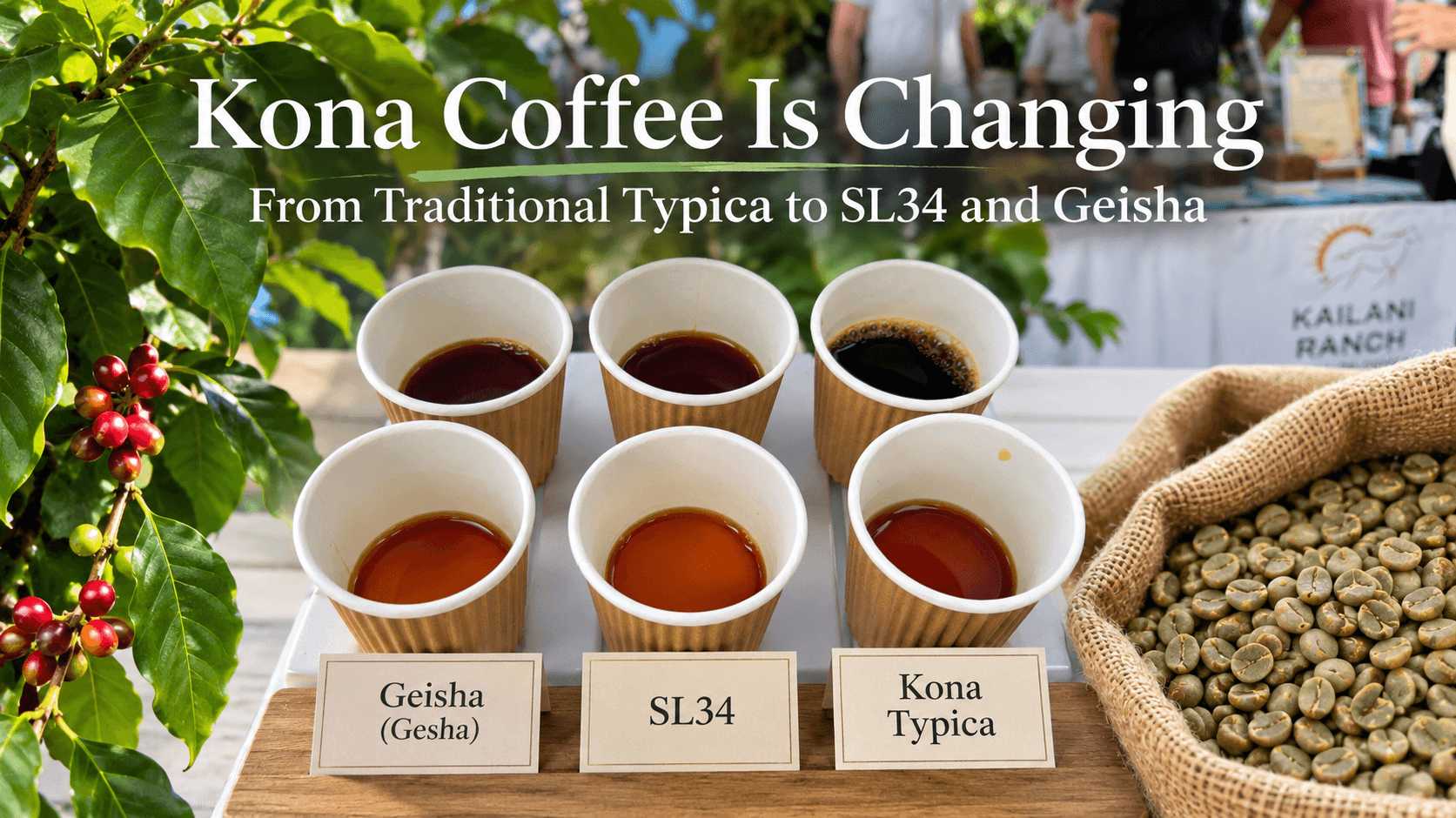
Instead of simply tasting Kona coffee, we encountered tasting flights featuring traditional Kona Typica, SL34, and Geisha. This was particularly interesting because the differences were not just about roasting styles. We were tasting coffees with different genetic characteristics, all grown within the Kona region.
Now, I'm certainly not the coffee expert in our family. That title belongs to Kumi.
While tasting SL34, Kumi immediately noticed its floral aroma. I had to think about it for a moment.
To me, SL34 had a distinctive, bold taste with a tart note. Not bold in the sense of bitterness, but with more pronounced and clearly defined flavors. It seemed to have more character and perhaps a little more complexity than the traditional Kona coffee I was accustomed to. Some may say it's more refreshing. Some say "sour."
At least, that was my impression. And what do I know?
Farms such as Kona Ha Coffee offered SL34 and Geisha, but after tasting both varieties, we actually preferred their traditional Kona coffee. So that's what we purchased.
Coffee is a matter of personal preference, and traditional Kona Typica still has plenty to offer.
Kona Typica, SL34, and Geisha: Understanding the Differences
First, an important distinction. Kona coffee refers to geographic origin, while Typica, SL34, and Geisha refer to coffee plant varieties. It took me a few years to understand this.
Coffee grown within the designated Kona coffee region may qualify as Kona coffee regardless of its plant variety, subject to applicable origin and labeling requirements. In other words, Kona coffee is not limited to Kona Typica.
This is similar to the wine industry. Napa Valley identifies where a wine comes from, while Cabernet Sauvignon, Pinot Noir, and Chardonnay identify different grape varieties. The same distinction is becoming increasingly relevant in Kona coffee.
Traditional Kona Typica: The Classic Kona Flavor
Typica has been closely associated with Kona coffee for generations. Its flavor is generally smooth, balanced, and approachable, often featuring nutty, chocolate, and subtle sweet characteristics.
For many coffee drinkers, this is the familiar Kona experience. It offers richness without overwhelming bitterness and is especially pleasant as an everyday morning coffee.
Of course, flavor also depends on the farm, elevation, harvest conditions, processing, and roasting. Not every Kona Typica will taste exactly the same. Processing plays a big role also, but this is a whole other subject.
Still, there is a reason traditional Kona coffee has maintained its reputation for so many years. Our experience at Kona Ha Coffee certainly reminded me that the classic is hard to beat.
SL34: A Specialty Variety With Kenyan Roots
SL34 originated in Kenya during the 1930s and became known for its potential to produce high-quality coffee with bright acidity, fruit-forward flavors, and a distinctive finish.
Unlike the relatively mellow characteristics often associated with traditional Kona Typica, SL34 can offer a more pronounced flavor profile. Its intensity does not necessarily come from bitterness or dark roasting. Instead, it can come from the coffee's natural acidity, aromatics, and fruit characteristics. For me, it feels too acidic.
Geisha (Gesha): Floral Aromas and Delicate Complexity
Geisha originated in Ethiopia and gained international recognition through specialty coffee production in Panama.
It is particularly well known for its floral aroma, sometimes compared to jasmine, along with citrus, bergamot, and tea-like characteristics. At its best, Geisha can be remarkably aromatic, delicate, and complex.
For someone accustomed to dark-roasted coffee, Geisha may be a completely different experience. My tongue is not sophisticated enough to taste all characteristics, but it is very different from regular Kona Typica.
It is also worth remembering that the variety alone does not guarantee quality. Growing conditions, processing, roasting, and preparation all influence the final cup. A well-produced Typica can easily be more enjoyable than an average Geisha, depending on personal taste. I like traditional Typica more.
Kona Coffee Competitions Reflect a Changing Industry
The evolution of Kona coffee is also becoming visible in local coffee competitions.
This year, the Kona Coffee Cupping Competition features two divisions that recognize both traditional coffee production and newer approaches.
The Heritage Division focused on traditional washed Kona Typica, while the Creative Division offered a space for other Kona-grown varieties and processing methods. I find the Creative Division particularly interesting because it acknowledges that Kona's coffee identity can evolve without losing its traditional foundation.
In 2025, Hawaiian Goat Coffee won overall first place with its SL34, scoring 86.58 points. Kona Farm Direct placed second, followed by Hula Daddy Kona Coffee. Gesha and SL34 took the top three. I wonder what will happen in 2026.
The competition structure recognizes both sides of the industry: preserving the quality and heritage of traditional Kona Typica while allowing farmers to experiment with different varieties and processing techniques.
Kona SL34 Gains International Recognition in Dubai
Another notable development occurred in February 2025, when a Kona-grown SL34 coffee from Kona Farm Direct sold for $910 per kilogram(about 2 lb) at the Dubai Specialty Coffee Auction.
That is approximately $413 per pound! The sale was reported as a record auction price for American-grown coffee and attracted attention from the international specialty coffee market.
Of course, this was an exceptional auction lot, not the typical retail price of Kona coffee. Specialty coffee auctions often involve small quantities of carefully selected beans, and their prices should not be confused with what consumers normally pay at a local coffee farm.
Nevertheless, the result is significant.
Historically, Kona coffee's international reputation has been closely associated with its geographic origin and smooth, balanced flavor. Specialty varieties such as SL34 are introducing another dimension, allowing Kona farmers to receive recognition for distinctive flavor profiles and exceptional individual lots.
For a relatively small coffee-growing region in the middle of the Pacific, that is quite an achievement.
The Future of Kona Coffee: Tradition and Innovation
In the future, ordering "Kona coffee" may be only the beginning of the conversation. We may find ourselves discussing whether it is Typica, SL34, or Geisha, as well as the specific farm, elevation, roasting style, and processing method.
At the same time, I hope traditional Kona Typica continues to receive the recognition it deserves. Innovation does not need to replace tradition. Both can coexist, giving consumers more choices while preserving Kona's agricultural heritage.
And as we discovered at the Coffee Stroll, innovation is not limited to coffee beans. Products such as Kona Coffee Butter and Kona Coffee Iced Tea demonstrate how local producers are finding new ways to share their harvests.
Kona Coffee and the Big Island Lifestyle
For those who know Kona primarily through its oceanfront resorts, golf courses, and beautiful coastline, the coffee-growing communities on the slopes of Hualālai offer another perspective on island life.
Holualoa, in particular, reflects the agricultural and community character that has existed alongside Kona's growth as a residential and resort destination. The village also has a deep-rooted Japanese Immigrant history.
Unlike many mainland coffee markets, where consumers mainly experience coffee through cafés and retail stores, Kona offers the opportunity to visit farms, meet growers, and taste coffee close to where it was produced. Coffee connects Kona's history, agriculture, economy, and people. And as farmers introduce new varieties, that connection continues to evolve.
Next time you're visiting Holualoa or a local Kona coffee farm, I recommend trying a tasting flight if one is available. Compare traditional Typica with SL34 or Geisha. You may discover an entirely new favorite, or, like us at Kona Ha Coffee, you may decide that you still prefer the traditional Kona flavor.
Either way, it's an enjoyable way to learn more about the coffee we produce here on the Big Island.
And if you can identify those floral notes as quickly as Kumi, you're already ahead of me!
Frequently Asked Questions
What is the difference between Kona coffee and Kona Typica?
Kona coffee refers to coffee grown within the designated Kona coffee-growing region on the Big Island of Hawai‘i. Kona Typica refers to a traditional coffee plant variety closely associated with the region. Kona-grown SL34 and Geisha may also qualify as Kona coffee when they meet applicable origin and labeling requirements.
What is SL34 Kona coffee?
SL34 Kona coffee is coffee grown in the Kona region using the SL34 plant variety, originally selected in Kenya. It is known for its potential to produce bright acidity, fruit-forward flavors, and distinctive aromatics. Its flavor can differ considerably from traditional Kona Typica depending on growing conditions, processing, and roasting.
What is Geisha coffee, and is it grown in Kona?
Geisha, also spelled Gesha, is a coffee variety originating from Ethiopia that became internationally recognized through specialty coffee production in Panama. Some Kona farms grow Geisha as a specialty variety. It is often associated with floral aromas, citrus notes, and delicate, tea-like characteristics.
Is SL34 or Geisha better than traditional Kona Typica?
Not necessarily. SL34 and Geisha can produce distinctive specialty coffees, but quality depends on growing conditions, processing, roasting, and personal taste. Traditional Kona Typica remains valued for its smooth, balanced flavor. During the 2026 Holualoa Coffee & Art Stroll, our family actually preferred the traditional Kona coffee offered by Kona Ha Coffee over its SL34.
Why is Kona coffee so expensive?
Kona coffee is produced in a relatively small geographic region where land, labor, farm maintenance, harvesting, and processing can be costly. Limited production and strong recognition of the Kona name also influence pricing. Rare specialty varieties and exceptional auction lots can command significantly higher prices, but these do not represent typical retail coffee prices.
What makes the Kona coffee-growing region unique?
Kona's coffee-growing region is located along the slopes of Hualālai and Mauna Loa on the western side of the Big Island of Hawai‘i. Elevation, volcanic soils, sunshine, rainfall patterns, and local growing practices all influence coffee production. Individual farms can produce different flavor profiles even within the same growing region.
What is the Holualoa Coffee & Art Stroll?
The Holualoa Coffee & Art Stroll is an annual community event held in Holualoa, a historic village above Kailua-Kona. Local coffee farms present their harvests for tasting while visitors enjoy art galleries and the village atmosphere. In 2026, our family sampled coffee from all 24 participating farms.
Why are Kona coffee farmers growing new varieties?
Some Kona farmers are experimenting with varieties such as SL34 and Geisha to explore different flavor profiles, improve product differentiation, and participate in specialty coffee markets. These efforts complement traditional Kona Typica production rather than necessarily replacing it.
What was significant about the Kona SL34 coffee auction in Dubai?
In February 2025, an SL34 coffee from Kona Farm Direct sold for $910 per kilogram at the Dubai Specialty Coffee Auction, reportedly setting a record for American-grown coffee. The exceptional price demonstrated international interest in Kona-grown specialty coffee, although it was not representative of everyday retail pricing.
Where can visitors taste different varieties of Kona coffee?
Visitors can explore coffee farms in the Kona growing region, particularly around Holualoa and the slopes above Kailua-Kona. Some farms offer tastings or flights comparing different varieties and processing methods. Availability varies by farm and season. Community events such as the Holualoa Coffee & Art Stroll also provide opportunities to compare multiple local producers.