


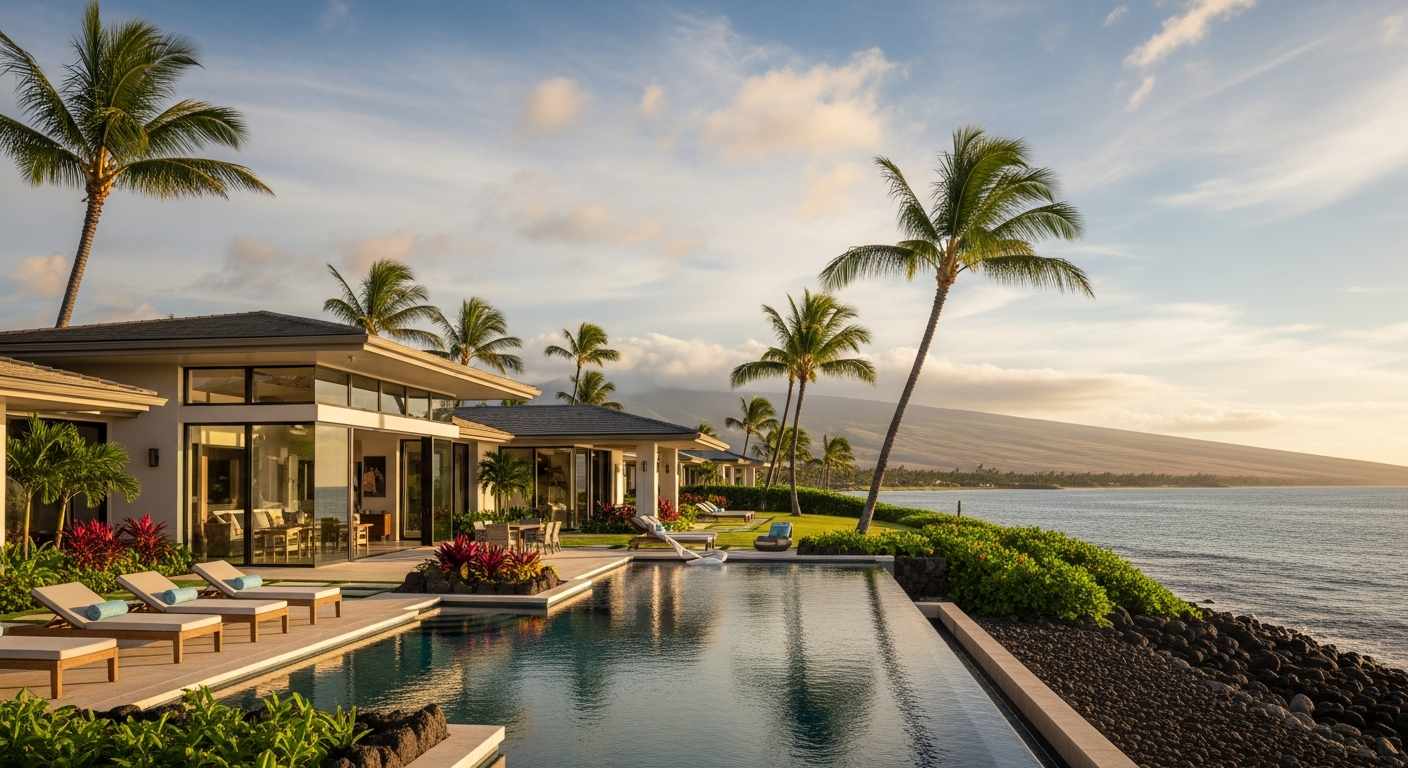
title: “Kukio Hawaii — The Definitive Guide to Big Island Exclusive Living”
slug: keteam-kukio-hawaii-the-definitive-guide-to-big-island-exclusive-living
client: keteam
calendarId: 150
status: draft
scheduledDate: 2026-05-12
author: “The KE Team”
category: Community Guides
pillar: /big-island-luxury-communities/
hero_image: keteam-kukio-hawaii-the-definitive-guide-to-big-island-exclusive-living.png
date: 2026-05-12
meta_description: “Kukio Hawaii deep dive: club model, golf, Ocean Club, lot vs home pricing, membership, rules, and how to buy into the Big Island’s most private community.”
keywords: [“Kukio Hawaii”, “Kukio Golf and Beach Club”, “Kukio real estate”, “Kukio homes for sale”, “Kukio membership”, “Big Island private club”, “Kona Coast luxury”]
fact_check_source: Hawaii_Communities_Guide.md
Kukio is the quietest name in Big Island luxury real estate, and that is exactly how the community is engineered. While Hualālai sits next door with a Four Seasons hotel on its lawn and Kohanaiki runs the largest private clubhouse in West Hawaii, Kukio operates the way a serious private country club is supposed to operate: invisibly. There is no resort layer, no public tier, no easy way to “tour” the inside without a relationship with a member or a buyer’s agent. The result is the most restrained, owner-focused community on the Kona Coast.
This is the KE Team’s definitive overview of Kukio — how the club is structured, how golf and the Ocean Club work, how lot and home pricing actually behave, and what the buyer process looks like for anyone serious about ownership.
What Kukio is — and isn’t
Kukio Golf and Beach Club is one of three true private, member-driven communities on the Big Island, alongside Hualālai Resort and Kohanaiki. The three sit on a contiguous stretch of the Kona Coast and share the same dry, sunny, leeward microclimate — but they don’t share a model. Hualālai is a semi-private resort community anchored by the Four Seasons. Kohanaiki is a newer, more social, more accessible private club still under active build-out. Kukio is the most restrictive of the three by design.
A single rule captures the entire culture: unaccompanied guest use is not permitted. If you are not on property, your friends, family, or rental guests cannot use the home, the Ocean Club, or the golf courses. That policy is not a small footnote — it is the structural reason Kukio feels different the moment you step onto property. Short-term vacation rentals are not the focus. Owner use is.
If you are comparing across Kukio, Hualālai, and Kohanaiki and you keep landing on “I want maximum privacy, I want a club that stays consistent for decades, and I am not buying for rental income,” you are describing Kukio.
The history and the philosophy
Kukio was developed in the early 2000s on a stretch of Kona Coast that had been part of the broader Hualālai land assemblage. Where Hualālai paired with Four Seasons and built a hotel-anchored resort, Kukio took the opposite path: build a strictly private club with controlled membership, controlled density, and member-only amenities — and keep the entire operation low-profile.
The result is a community that markets itself almost entirely by word of mouth. Members refer members. Buyers find Kukio through their agents, through their network, or through families who already own there. The brand discipline is intentional — and it’s part of why Kukio has held value through every cycle since opening.
Amenities — what membership actually delivers
Amenities at Kukio are entirely member-focused. They include:
- Two golf experiences — an 18-hole championship course and a 10-hole short course
- A private clubhouse and dining — multiple settings, member-only
- The Ocean Club — direct beach access with full beach-side service
- Fitness center and spa
- Additional recreational facilities — including ocean-sports infrastructure
Both golf courses are private. They are available only to members and their accompanied guests. There is no hotel-guest tier, no resort access path, no public play. That single fact is the reason course conditions, tee-time availability, and pace of play at Kukio stay consistent year-round — there is no seasonal swing driven by hotel occupancy.
The same logic applies to the Ocean Club. At a hotel-anchored community, the beach can shift dramatically depending on whether the resort is at 90% occupancy or 50%. At Kukio, the Ocean Club is sized for the membership. If you are there in July or October or February, the experience is the same.
What it’s like to live at Kukio
The daily rhythm at Kukio is quieter than what most first-time visitors expect. Mornings at the Ocean Club are unhurried. Tee times exist but aren’t fought over. The 10-hole short course is genuinely playable on a one-club afternoon walk. Dining is member-only, which means the dining room behaves more like a private restaurant than a hotel restaurant — staff know members by name, kids’ menus are kept in the kitchen, and reservations rarely block a visit.
The trade-off — and it is a real trade-off — is structural rather than service-related: if your lifestyle depends on rotating houseguests through the property while you’re back on the mainland, Kukio is not the right fit. The unaccompanied-guest-use rule means the home is fully yours, every day, but it has to be yours.
Real estate at Kukio — lots, homes, and how pricing behaves
Inventory at Kukio is intentionally constrained. There are a defined number of homesites, and resale-driven turnover is modest. For long stretches of the cycle there simply is not much for sale, which is a feature for owners and a patience requirement for buyers.
When inventory does come available, it generally falls into three categories:
1. Homesites (lots). Buyers who want to design their own home from the ground up. Kukio’s architectural standards are firm — the goal is visual harmony with the lava, the shoreline, and the trade-wind orientation — but within those guidelines there is real design freedom. Lot pricing varies dramatically by location, view corridor, and proximity to the Ocean Club; oceanfront and ocean-bluff parcels carry the largest premium.
2. Resale homes. Existing residences range from refined single-level estates on interior lots to larger oceanfront compounds. Because Kukio enforces consistent quality and aesthetic, even older homes tend to wear well rather than feel dated.
3. Compound and multi-parcel opportunities. Less common, but they do appear — buyers assembling a primary residence plus a guest house or staff residence across adjacent parcels.
We avoid quoting public price ranges in writing because the band is wide and shifts meaningfully with each cycle. What we tell buyers in private brief is the actual recent comparable sales — what cleared in the last 6 to 18 months, by lot type and home size, and how those numbers compare to current asking prices. That’s the data that matters. If you’d like the current snapshot, reach out to us and we’ll send a private update tied to whichever home or lot type fits your search.
Club membership — how it works
Kukio operates a membership structure that is tied directly to property ownership in the community. Membership entry is limited, and the club retains real discretion over the process. There is no public application form on a website, and there should not be — that’s how the community keeps the experience consistent for the existing membership.
In practice, the membership conversation is part of the real estate transaction. A serious buyer is walked through both pieces — the home purchase and the membership process — simultaneously. Your agent, working alongside the club, helps you understand the current initiation, the annual dues, the food-and-beverage minimums, and the structure of the rights you are buying. Those numbers are not posted, and they shift over time. Anyone quoting them off a website blog post is quoting stale information.
Golf at Kukio — both courses, both ways
The championship 18-hole course and the 10-hole short course operate as the two pillars of Kukio golf, and they reward two different golf personalities.
The championship course is a full-day round if you want it to be — a real test, ocean wind exposure, varied elevation, and a routing that ties into the volcanic coastline. Member play is unhurried. Pace, conditions, and field stay consistent because there is no hotel-guest play running through.
The 10-hole short course is a different animal. It’s social golf. It’s a one-bag carry, a 90-minute afternoon, three generations of one family on the same loop. For owners with kids and grandkids learning the game, it has been one of the most-loved amenities at the club. For empty-nesters who want to play three afternoons a week without committing to a full 18 each time, it’s equally valuable.
Compare that against the rest of the Big Island private golf landscape: Hualālai’s Keolu course is also fully private to members, and Hokuli’a in South Kona is private as well. Kohanaiki’s course is private to its membership. Outside the private tier, Nanea has been rated by Golf Digest as the #1 course in the state but is purely a golf club with no real estate. Mauna Kea and Hapuna are public. The combination of two member-only courses and the full Ocean Club is one of the things that keeps Kukio in its own tier.
The Ocean Club — the heart of the community
If golf is one pillar of Kukio, the Ocean Club is the other — and for many members, it is the bigger one. The Ocean Club gives members and their accompanied guests direct, member-only beach access with on-property service: dining, equipment, ocean activities. The shoreline along this stretch is one of the genuinely usable beach experiences on the Kona Coast — calm enough for daily swimming, kid-friendly, with reef and sea life close in.
The functional advantage over a resort beach is consistency. Member-only access keeps the density manageable through every season. The dining and service team work for the membership, not for an outside hotel operator. Your kids’ and grandkids’ Hawaii memories — the ones they’ll come back to for the next 30 years — happen here.
Who Kukio is for, and who it isn’t
Kukio fits a specific buyer profile. It is the right call if:
- You want a fully private Hawaii retreat with no resort tier and no public access
- You value scarcity, restraint, and a community that will look the same in 20 years as it does today
- You are not buying for rental income — owner use is the model
- You want member-only golf and an Ocean Club with controlled density
- You’re prepared to wait for the right inventory, because the right inventory at Kukio doesn’t come up every month
It is not the right fit if you need short-term rental flexibility, if your use case depends heavily on unaccompanied guests staying at the property while you’re on the mainland, or if you want a louder, more socially programmed clubhouse. For the rental case, Hualālai is structured for exactly that. For the more social, modern, new-construction case, Kohanaiki is the natural alternative.
How the buying process actually runs
A serious Kukio purchase typically runs across four phases:
1. Pre-tour briefing. Before you fly in, your buyer’s agent walks you through the current inventory snapshot, the membership structure, and the questions worth resolving up front. This is where unrealistic timelines or mismatched expectations get surfaced — better at the briefing stage than mid-tour.
2. On-property tour. Multiple home and lot showings inside the community, time at the Ocean Club, time at the clubhouse, ideally a round on one or both courses. The goal is to leave with the community itself ranked clearly, even if the specific home isn’t yet chosen.
3. Membership conversation. Initiated in parallel with the real estate offer. The club’s perspective on the buyer matters and is part of the transaction structure.
4. Closing and onboarding. Both the property and the membership close together. Onboarding includes orientation to club facilities, golf, dining, and the Ocean Club staff.
Timelines vary, but six to twelve weeks from first tour to close is typical when inventory aligns. When a buyer has very specific oceanfront criteria and current inventory doesn’t match, the right answer is often patience — the community delivers exactly what it advertises, but only on its own clock.
A note on long-term value
Kukio’s value discipline comes from the same source as the lifestyle — controlled membership, controlled density, controlled rental policy. That structure protects existing owners from the dilution that public resorts and rental-heavy communities can experience over time. The community is small enough, and the architectural standards firm enough, that a property bought today still belongs to the same Kukio in 20 years. For multi-generational ownership — the kids and grandkids using the home into the 2040s — that consistency is the entire point.
What to do next
If Kukio is on your shortlist, the most useful first step is a private inventory and pricing brief — current homes, current lots, recent comparable sales, and a clear walk-through of the membership process. We don’t publish those numbers in blog posts because they shift in real time, and stale figures cause real damage to a buyer’s expectations.
Contact the KE Team and we’ll put a private Kukio brief in front of you, along with a tour structure for your first trip that respects the community’s pace and gets you to a decision without the noise. If you want to see how Kukio compares to its two neighbors first, start with Kukio vs Hualalai vs Kohanaiki and the Hualālai and Four Seasons Resort guide. Kukio rewards buyers who do their homework — and we’re set up to help you do it quietly.