
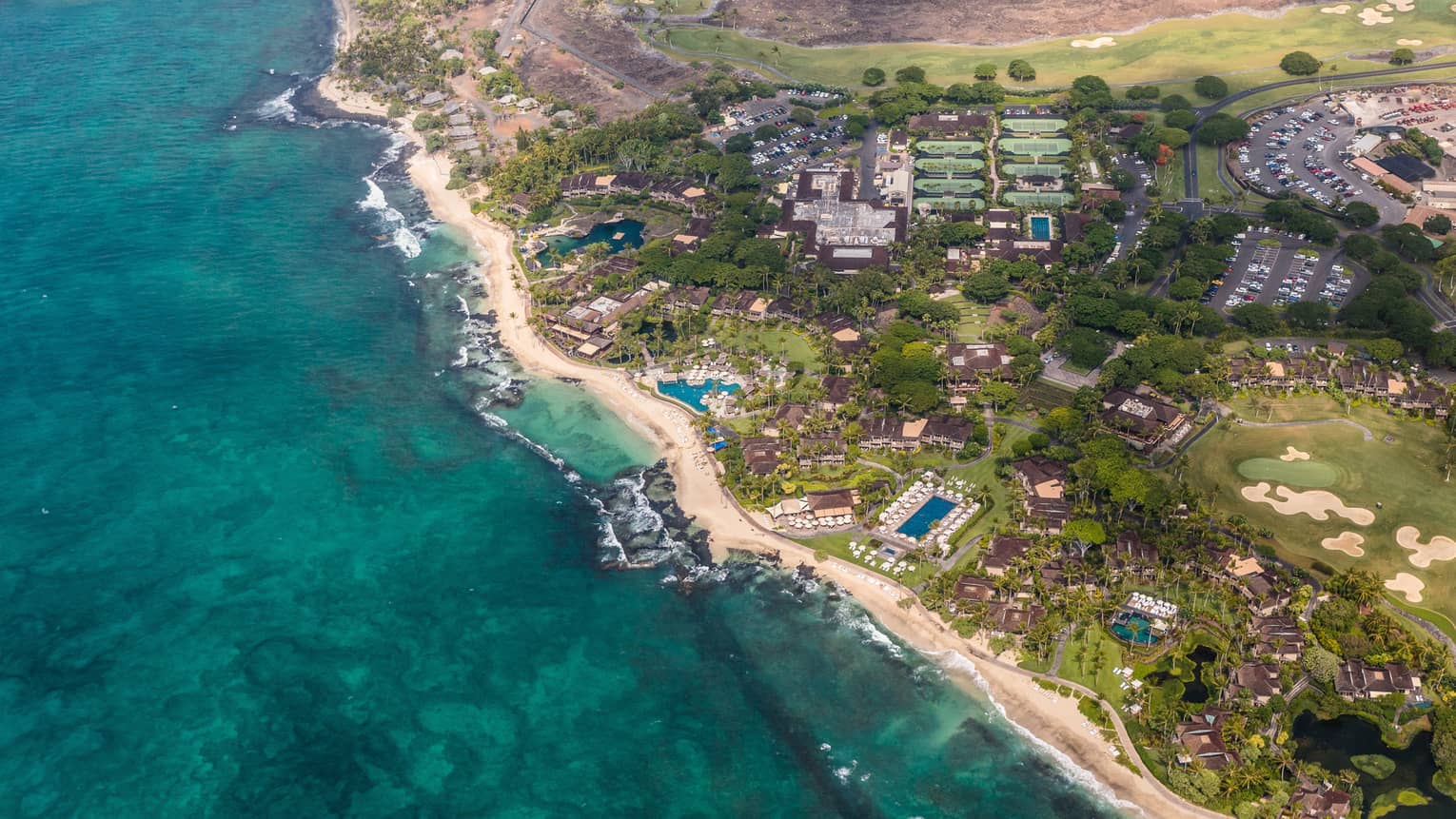
Hualalai Four Seasons Resort Real Estate Guide
Hualālai Resort is the most unusual of the three private-club communities on the Big Island, and for many buyers it's the most practical. The community sits along the Kona Coast next to Kukio, shares the same dry, sunny, leeward microclimate, and runs a serious private club — but it does all of that with a Four Seasons Resort Hualalai anchoring the property. The hotel makes Hualālai feel different the moment you arrive. It also unlocks the single feature that drives a meaningful share of Hualālai purchasing decisions: rental flexibility.

This is the KE Team's working guide to Hualālai real estate — how the Four Seasons relationship shapes ownership, how the Hualālai Club works, how the two golf courses operate, and the questions that actually decide whether Hualālai is the right Kona Coast home for you.
What Hualālai actually is
Hualālai Resort is one of three true private, member-driven communities on the Big Island, alongside Kukio Golf and Beach Club and Kohanaiki. But unlike the other two, Hualālai is anchored by a working luxury hotel — the Four Seasons Resort Hualalai — and that anchor changes the entire ownership model. The community is more accurately described as a semi-private resort community: a serious private club layered onto a Four Seasons-managed resort, with member-only amenities running parallel to the hotel's.
That structure is not a compromise. It's a deliberate model that gives owners three things that other private clubs can't always offer at the same time:
Short-term vacation rentals are allowed — a real ownership lever
Four Seasons-grade service and infrastructure — pools, dining, spa, activities, staff
A private Hualālai Club with its own course, pools, fitness center, and dining — separate from the hotel
If you're weighing Hualālai against Kukio and Kohanaiki, this is the structural distinction to anchor on. Kukio is fully owner-use, no hotel, no rentals. Kohanaiki is rental-restricted with a larger, more social clubhouse but no Four Seasons attached. Hualālai sits in a category of its own — flexibility plus club discipline.
The Four Seasons connection — what it actually unlocks
Four Seasons Resort Hualalai is not a separate facility you happen to live near. It is integrated into the community. As an owner, you have access points into the hotel's services and infrastructure that most resort buyers can't replicate elsewhere on the Big Island. The hotel runs full-service dining, pools, beach service, a spa, kids' programs, and the kind of guest-services backbone that only a Four Seasons operates at scale.
For owners, three implications matter:
Rental viability. When you're not in residence and want the property to generate income, the Four Seasons infrastructure is the reason Hualālai rentals function at a different level than rentals at a community without an attached hotel. The hotel staff base, the maintenance standards, the guest-services depth — all of it raises the floor on what a rental experience looks like for your guests, which in turn supports nightly rates and occupancy.
Easy guest hosting. Family and friends coming to use the home can fold into the hotel layer at any time. They can dine at the hotel restaurants, use hotel-side services, or simply experience the resort programming alongside their stay at your home.
Service consistency. Even when you're in residence and not using hotel services, the standards spill over into the community generally — landscaping, road maintenance, security, ambient quality.
The Hualālai Club — the private layer
Many first-time visitors miss this entirely, but Hualālai operates a separate Hualālai Club that is fully member-only. It is not the hotel. It is a dedicated club layered on top of the resort, sized and programmed for the membership, with its own amenities:
An 18-hole golf course designed by Tom Weiskopf
A driving range
Member pools and dining
A fitness center separate from the hotel
When members talk about "the club" at Hualālai, they are not talking about the hotel pool or the hotel gym. They mean this. The club is what gives Hualālai its private-community feel underneath the hotel anchor. You can spend a full day at Hualālai without setting foot in the resort, because the club has the full amenity stack a serious private community needs.
Golf at Hualālai — two courses, two access models
Golf at Hualālai is one of the more nuanced parts of the community to explain, because two courses run side by side with different access rules.
Hualālai Golf Course (Jack Nicklaus signature). A PGA Tour caliber Nicklaus signature design. Access is restricted — open to resort hotel guests and Hualālai Club members, but not to the general public. This is the course visitors see if they stay at the Four Seasons.
Keolu Golf Course. Fully private. Reserved exclusively for Hualālai Club members. Hotel guests do not play Keolu. The public does not play Keolu. It is a member-only course in the same sense that Kukio's two courses are member-only.
That dual structure is one of the things that meaningfully separates Hualālai from a typical hotel-anchored resort community. Members keep a private course of their own regardless of how full the hotel runs. When the resort is at high occupancy and Hualālai Nicklaus tee times are tighter, Keolu is still there. When you want a course that plays at member pace year-round, Keolu delivers exactly that.
Compared to the broader Big Island golf landscape, Hualālai's two-course design sits in the same private tier as Kukio (two member-only courses) and Kohanaiki (one member-only course). Outside the three private clubs, Mauna Kea and Hapuna are public, the Waikoloa Beach courses are public, and Nanea — rated by Golf Digest as the #1 course in the state — is a private golf club with no real estate.
Rental flexibility — the lever Hualālai owns
This is the most important section of this guide for buyers comparing across the three private clubs.
Hualālai allows short-term vacation rentals. Kukio's model is built around owner use and does not allow unaccompanied guest use of the property. Kohanaiki generally does not allow short-term rentals (with limited use tied to specific membership programs). Hualālai is the one community in the private-club tier where rental income is a deliberate part of the ownership thesis.
That matters for two buyer profiles in particular:
The part-time owner. If you intend to be in residence two to four months a year and want the home to generate income the rest of the time, Hualālai is the only one of the three structured to support that without friction. The Four Seasons infrastructure makes the actual rental experience high-quality and consistent for your guests, which protects nightly rates over time.
The legacy-asset owner. If you're buying for multi-generational use — kids and grandkids, family stays you may not personally attend — Hualālai's more flexible guest-use posture matters. At Kukio, unaccompanied guest use is not permitted. At Hualālai, family arrangements work without bending rules.
The trade-off is real: a community that allows rentals will, by definition, have more transient guest activity than a community that doesn't. Kukio is a quieter day-to-day environment because of its rule structure. Hualālai's energy is higher because the resort and the rental layer are part of the model. Neither is "better" — they are different products solving for different ownership goals.
Real estate at Hualālai — inventory categories
Inventory at Hualālai generally splits into a few categories:
Resort villas and condominiums. Smaller-footprint residences integrated with the resort, often the entry point into Hualālai ownership. Strong rental performance because of the resort proximity.
Single-family homes. Detached residences throughout the community, ranging from refined single-level designs to larger compounds. Architectural standards are firm — the community is intentionally cohesive in look and feel.
Oceanfront and ocean-bluff estates. The top of the market. Limited in number, and the largest premium category. Resale-driven, with the highest absolute price points in the community.
We don't publish price bands in writing because the range is wide and shifts meaningfully with each cycle. Recent comparable sales — what cleared in the last 6 to 18 months by home type, square footage, and view corridor — are the figures that matter. If you'd like that current snapshot for Hualālai, reach out to us for a private brief.
A note on fractional ownership: Hualālai-area inventory occasionally includes fractional interest structures, generally tied to specific residence-club programs. Fractional is a legitimate ownership path for buyers who want true Four Seasons-managed access without full-home commitment. The trade-offs — flexibility windows, exchange rights, resale liquidity — are specific enough that they should be walked through in detail before any offer. Full whole-home ownership is the larger share of the market and is what most buyers we work with end up in.
The Hualālai Club — membership process
Membership in the Hualālai Club is tied directly to property ownership and runs parallel to the real estate transaction. The initiation, dues, and food-and-beverage minimums are not posted publicly, and the figures shift over time. Anyone quoting hard numbers from a generic blog post is quoting stale data.
The right way to understand the current structure is through a buyer's agent who is actively transacting in the community, walking you through the initiation tier, the annual dues, and the rights you are buying — at the same time as the home offer. Membership and home purchase close together.
A typical week as a Hualālai owner
The day-to-day rhythm at Hualālai differs depending on whether you're using the hotel layer or staying inside the club layer.
A club-side week looks a lot like Kukio: morning round at Keolu, lunch at the member dining room, afternoon at the member pool, light evening at the home. Service is consistent, traffic is low, the experience is private.
A resort-integrated week uses the Four Seasons more visibly. You might pull breakfast at one of the resort restaurants, take the kids or grandkids to the resort kids' program for the morning, spend the afternoon between the member pools and the resort pools, and end the evening at a hotel restaurant. The resort is there when you want it and out of the way when you don't.
Most full-time and serious part-time owners we work with use both layers, and the ability to move between them — without leaving the community — is a real part of the value.
Who Hualālai is for, and who it isn't
Hualālai is the right call if:
You want rental flexibility as part of your ownership thesis
You want easy guest hosting, including unaccompanied guest use
You value being inside a Four Seasons-managed resort as a backbone for service and infrastructure
You still want a real private club layer — Keolu, member pools, the Hualālai Club dining — separate from the hotel
You're comfortable with the higher ambient energy that a hotel-anchored community produces
It is not the right fit if you want a strictly owner-use private community with no hotel tier. For that profile, Kukio is the natural answer. It also isn't the right fit if you specifically want brand-new construction in a still-building-out private club — for that, Kohanaiki is the natural alternative.
How the buying process runs
A serious Hualālai purchase generally moves through four phases:
Pre-tour briefing. Inventory snapshot, rental-program economics if rental is part of your thesis, membership structure, fractional vs. whole considerations if relevant.
On-property tour. Time inside the community — multiple residence types if you're not yet sure which fits, time at the Hualālai Club, ideally golf at one or both courses, and a deliberate look at the Four Seasons layer as a guest amenity rather than just a hotel.
Offer and membership conversation in parallel. Real estate offer and Hualālai Club membership process running simultaneously.
Closing and onboarding. Property and membership close together. Onboarding covers club facilities, golf, dining, and resort access points.
Timelines vary, but six to twelve weeks from first tour to close is typical when inventory aligns.
What to do next
If Hualālai is on your shortlist, the most useful first step is a private inventory and rental-economics brief — current homes, recent comparable sales, current rental performance figures if income matters to your thesis, and a clear walk-through of the membership process.
Contact the KE Team and we'll send a private Hualālai brief along with a structured tour plan for your first trip. If you're still comparing communities, the two that sit closest to Hualālai are Kukio and Kohanaiki — they look similar at first glance but solve for very different ownership goals, and the right answer is rarely a coin flip.
Frequently Asked Questions
Can you rent out a home at Hualalai?
Yes. Hualālai allows short-term vacation rentals, and it is the one private-club community on the Kona Coast structured around rental flexibility. The attached Four Seasons Resort infrastructure is what keeps the rental experience consistent for guests, which supports nightly rates and occupancy when you're not in residence.
What is the difference between Hualalai and Kukio?
Both are private clubs that sit side by side on the Kona Coast, but the ownership models are opposite. Kukio is strictly owner-use — no hotel, no short-term rentals, no unaccompanied guest use — while Hualālai is anchored by the Four Seasons and permits both rentals and family guest use. Kukio is the quieter environment; Hualālai trades some of that quiet for flexibility.
Do you have to join a club to own at Hualalai?
Membership in the private Hualālai Club is tied to property ownership and closes alongside the home purchase. The initiation tiers, dues, and food-and-beverage minimums aren't published and change over time, so they should be reviewed with an agent actively transacting in the community rather than taken from any blog figure.
How many golf courses does Hualalai have?
Two. The Jack Nicklaus signature Hualālai Golf Course is open to resort hotel guests and Hualālai Club members, while the Keolu course is reserved exclusively for members. Hotel guests and the public do not play Keolu, which gives owners a private course that stays at member pace regardless of resort occupancy.
Where is Hualalai located on the Big Island?
Hualālai Resort is on the Kona (leeward) coast at Historic Ka'ūpūlehu, north of Kailua-Kona and only minutes from the Kona International Airport. It shares the dry, sunny microclimate of the west side, which is the driver behind most Big Island second-home demand.
What types of homes are available at Hualalai?
Inventory generally falls into three tiers: resort villas and condominiums (the usual entry point, with strong rental performance), single-family homes throughout the community, and a limited number of oceanfront and ocean-bluff estates at the top of the market. Fractional-interest residence-club options also surface occasionally for buyers who want managed access without a full-home commitment.
Is Hualalai a good real estate investment?
Hualālai's combination of rental flexibility and a Four Seasons brand backbone tends to support steady demand relative to communities without an attached hotel. Rather than rely on a blanket return figure, the right read is a current comparable-sales and rental-performance brief for the specific home type and view corridor you're considering — reach out to the KE Team for that snapshot.