
Updated
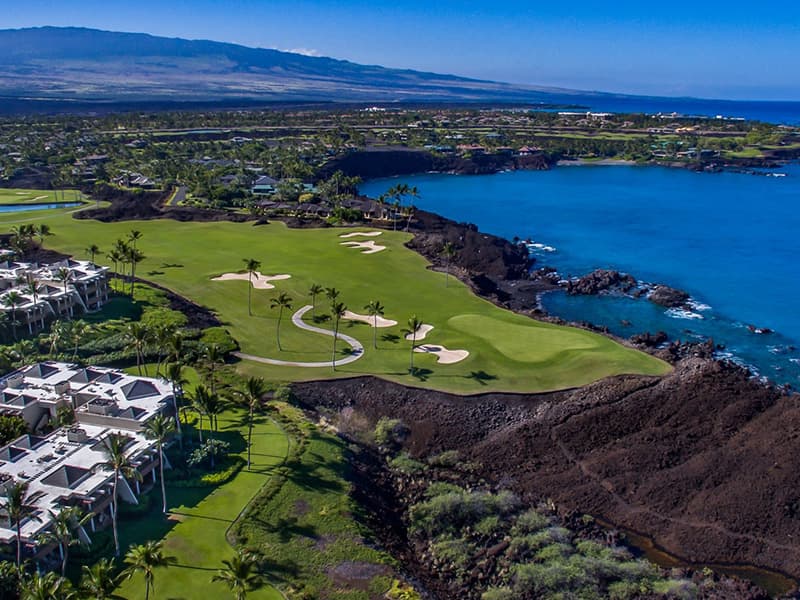
Mauna Lani Resort is a 3,200-acre master-planned luxury community on Hawaii Island’s Kohala Coast, organized around the protected Kalāhuipuaʻa ancient fishponds and anchored by the Auberge Resorts Collection’s Mauna Lani hotel and the Fairmont Orchid. Real estate at Mauna Lani is a mix of turnkey resort villas, custom fairway estates, and a tightly held tier of oceanfront trophy homes. Buyers come here for white-glove Auberge service, two championship golf courses, members-only beach club access at Pauoa Bay, and a gated, culturally rooted enclave that consistently trades at the top of Big Island prices.
Mauna Lani Resort Market Snapshot
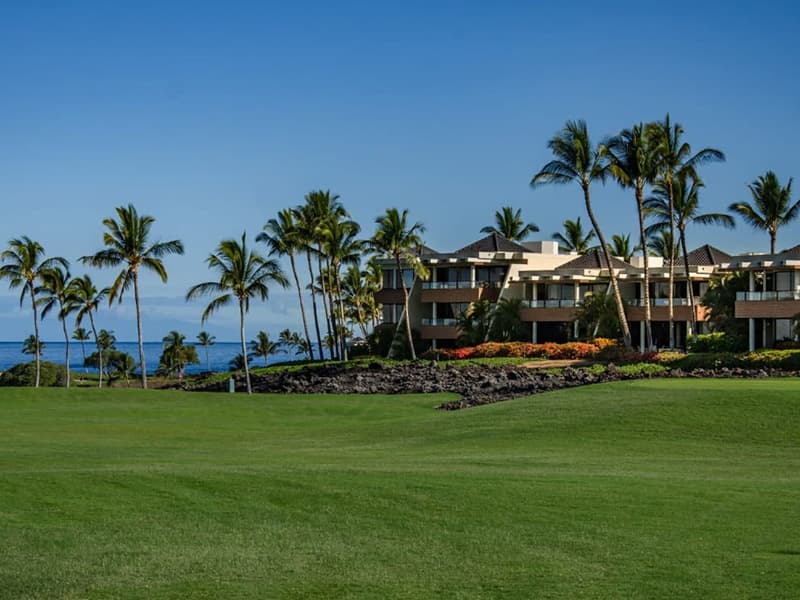
The 2026 Mauna Lani Resort market runs a median sale price of approximately $3.9M, with average days on market near 95 days and a year-over-year change of +4.8%, per Hawaii Information Service MLS data as of May 2026. Price per square foot averages roughly $1,450 across resort villas and single-family inventory. Oceanfront supply remains tight; resort villa inventory is steadier, with regular turnover at Mauna Lani Point, Islands at Mauna Lani, Kulalani, Palm Villas, Fairway Villas, and Champion Villas. Buyers should expect well-priced villas to move in 30 to 60 days, while custom fairway estates and oceanfront trophy homes generally trade after longer marketing windows in line with the 95-day average.
Resort villas typically enter the market between $1.6M and $2.5M for two-bedroom units in Kulalani or Islands at Mauna Lani. Custom fairway estates trade in the $4M–$8M range, while true oceanfront homes along Pauoa Bay and Makaiwa Bay reach $10M–$30M and beyond when they come available (HIS MLS, May 2026).
A Brief History of Mauna Lani Resort
Mauna Lani Resort sits on land long stewarded by Native Hawaiians, where the Kalāhuipuaʻa fishpond complex still functions much as it did when Hawaiian royalty used these aquaculture systems for sustenance and ceremony. The modern resort took shape in the 1980s under master planner Francis H. Iʻi Brown, whose vision integrated two championship golf courses with hundreds of acres of protected archaeological land. The flagship hotel went through a complete reimagination and reopened under the Auberge Resorts Collection in 2020, repositioning the property as a contemporary Hawaiian luxury destination while preserving the Kalāhuipuaʻa fishponds, petroglyph corridor, and surrounding cultural sites that define the resort’s distinct sense of place.
What Schools Serve Mauna Lani Resort
Mauna Lani Resort sits within the Kealakehe complex of the Hawaii Department of Education, with elementary and middle assignment to Waikoloa Elementary and Waikoloa Middle, and high school assignment to Kealakehe High School in Kailua-Kona (Hawaii DOE, 2025–2026 school year). Hawaii Preparatory Academy (HPA) in Waimea is the private-school option most resort families choose, about 25 minutes mauka from the resort gates. HPA offers PK–12, boarding from grade 9, and strong outcomes in college placement, marine science, and equestrian programs.
Neighborhood Character and Daily Life at Mauna Lani
Daily life at Mauna Lani Resort is organized around the beach, the golf, and a walkable resort village. Owners can move between the Mauna Lani Beach Club at Pauoa Bay, the Auberge spa, the two Francis Iʻi Brown courses, and the Shops at Mauna Lani (anchored by Foodland Farms, Tommy Bahama, and resort-side dining) without ever leaving the gates. Cultural programming through Auberge keeps the resort connected to the Kalāhuipuaʻa fishpond tradition and the petroglyph corridor that runs through the property’s makai stretch.
What stands out about Mauna Lani is how the price tiering follows the fishpond corridor. Properties closest to Pauoa Bay and the Kalāhuipuaʻa shoreline carry premiums that don’t fully show up in surface comps because that stretch is regulated as a National Historic Landmark and developable lot supply is permanently capped. The Auberge-side versus Fairmont-side distinction also affects how the resort lives day to day: Auberge-side villas like Mauna Lani Point and Champion Villas tend to attract more golf-driven owners, while Fairmont-side complexes such as Islands at Mauna Lani and Kulalani skew toward families using the resort pool complex and beach activities.
Architecture and the Built Environment
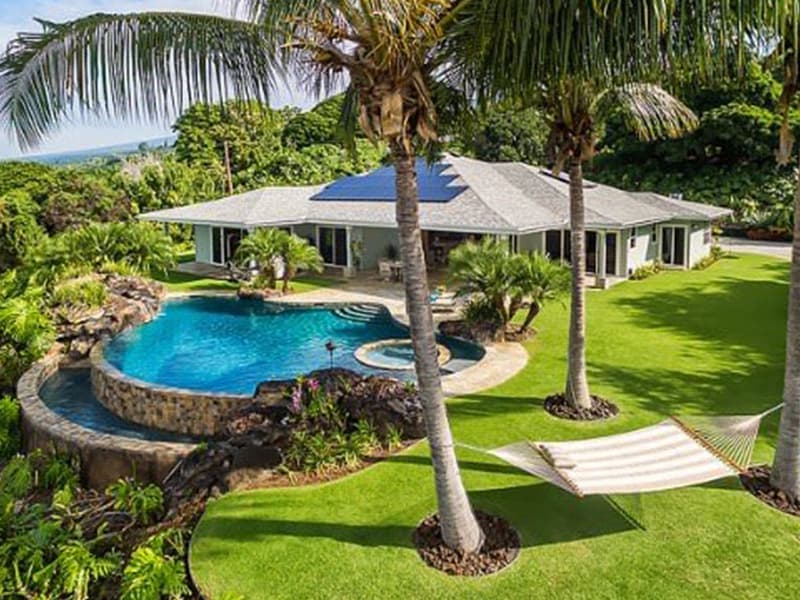
The dominant architectural language at Mauna Lani is contemporary Hawaiian: open lanais oriented to the tradewinds, lava-stone accents, deep roof overhangs, indoor-outdoor circulation, and pool-and-spa programs designed around sunset exposures. Villa complexes were built largely between the late 1980s and the mid-2000s, with several rounds of subsequent renovation. Custom fairway estates and oceanfront trophy homes are individually designed and tend toward larger floor plans (3,000–7,500 square feet), with the highest end pushing 10,000+ square feet on multi-parcel oceanfront assemblages.
Mauna Lani Villa Complexes and Estate Areas
Mauna Lani Point — oceanfront villa complex set on a protected bluff edge above the lava shoreline; tightly held two- and three-bedroom units with direct sunset exposure.
Champion Villas — fairway villas overlooking the South Course; popular with golf-focused owners.
Islands at Mauna Lani — single-level resort villas around a koi-pond water feature; family-friendly with pool and spa amenities.
Kulalani at Mauna Lani — newer multi-level villa community with larger floor plans and contemporary finishes.
Palm Villas and Fairway Villas — established complexes with a broader pricing entry point.
Custom estate areas — single-family fairway lots along the South and North Courses; a separately controlled tier of oceanfront parcels along Pauoa Bay and Makaiwa Bay.
Where Mauna Lani Resort Sits on the Kohala Coast
Mauna Lani Resort sits at roughly 19.94° N, 155.87° W on the South Kohala coastline, framed by Pauoa Bay to the south and Makaiwa Bay to the north. The map below centers on the Kalāhuipuaʻa fishpond corridor and the resort’s two hotel anchors.
Commute and Connectivity
Mauna Lani Resort sits roughly 35 minutes north of Kona International Airport (KOA) via the Queen Kaʻahumanu Highway. Kona services dozens of nonstop daily flights to West Coast hubs, and Kona Jet Center and Hawaii Aviation Services handle private aviation directly at KOA. Waimea (Kamuela) is 25 minutes mauka for HPA, the Parker Ranch corridor, and the gateway to Hāmākua Coast and Hilo for east-side day trips.
Adjacent Communities
Mauna Lani sits between two other Kohala Coast resort communities and within reach of several private members-only enclaves to the south. Mauna Kea Resort directly to the north is the original 1965 Rockefeller development, with the Mauna Kea Beach Hotel and Robert Trent Jones Sr. course defining a more legacy, mid-century-modern aesthetic. Waikoloa Beach Resort just to the south offers a broader villa and estate mix with two courses and more accessible entry pricing. Farther south, Hualalai and Kūkiʻo represent the ultra-private members-only end of the Kohala Coast luxury market.
Frequently Asked Questions
- What does Mauna Lani Resort real estate cost in 2026?
- The 2026 median sale price at Mauna Lani Resort is approximately $3.9M, with resort villas entering near $1.6M in Kulalani and Islands at Mauna Lani, mid-tier fairway homes trading in the $4M–$8M range, and oceanfront estates from $10M to $30M+. Average price per square foot runs near $1,450 per Hawaii Information Service MLS data as of May 2026.
- What is the difference between Mauna Lani Resort and Mauna Kea Resort?
- Mauna Lani is the younger, Auberge-managed resort built around the protected Kalāhuipuaʻa fishponds, with two Francis H. Iʻi Brown championship golf courses and the Fairmont Orchid. Mauna Kea Resort, just to the north, is the Kohala Coast’s original 1965 Rockefeller development, anchored by the Mauna Kea Beach Hotel and the Robert Trent Jones Sr. course. Both target similar buyers but offer distinct service cultures and inventory profiles.
- Can owners short-term rent at Mauna Lani Resort?
- Short-term vacation rentals are permitted at most Mauna Lani villa complexes, including Mauna Lani Point, Champion Villas, Islands at Mauna Lani, Kulalani, Palm Villas, and Fairway Villas, all zoned V (Resort) under Hawaii County code. Single-family fee-simple fairway estates carry different rules, so buyers focused on rental income should confirm zoning, CC&Rs, and HOA rules during due diligence.
- What is included with the Mauna Lani Advantage club membership?
- Mauna Lani Advantage unlocks access to the two Francis H. Iʻi Brown courses (South and North), the members-only Mauna Lani Beach Club at Pauoa Bay with Napua restaurant, the Auberge spa and fitness facilities, tennis and pickleball courts, and preferred dining rates across the resort. Membership tiers vary by property type and are tied to ownership within the gated villa and estate enclaves.
- Are there true oceanfront properties at Mauna Lani Resort?
- Yes, but true oceanfront inventory is exceptionally limited. A small tier of trophy estates sits directly above the lava coastline at Pauoa Bay and Makaiwa Bay, typically trading between $10M and $30M+ when they reach market. Oceanfront villa units at Mauna Lani Point offer a more attainable entry to near-water living, with direct sunset and coastline exposure from protected bluff-edge positions inside the gated complex.
- Which schools serve Mauna Lani Resort?
- Public school assignment runs through Waikoloa Elementary and Middle, then Kealakehe High School in Kailua-Kona, all within Hawaii Department of Education complex boundaries as of the 2025–2026 school year. Many resort families choose private Hawaii Preparatory Academy (HPA) in Waimea, about 25 minutes mauka, for its boarding program and college-prep curriculum.
Talk to KE Team Hawaii About Mauna Lani Resort
KE Team Hawaii — Kai Ioh and Emil Knysh of Compass — represents buyers and sellers across Mauna Lani Resort and the broader Kohala Coast. Reach out for private tours, due diligence guidance on resort fees and rental rules, and candid comparisons across Mauna Lani, Mauna Kea Resort, Waikoloa Beach Resort, and Hualalai. Start a conversation or explore live featured properties.
Kai Ioh · Hawaii Real Estate License RB-19352 · Compass · 75-1029 Henry Street, Suite 301, Kailua-Kona, HI 96740 · (808) 936-6148 · kai.ioh@compass.com