


By Kai Ioh and KE TEAM Hawaii
Kai Ioh is a luxury real estate advisor based in Kona, Hawai‘i, specializing in second home, resort, and ultra-high-net-worth markets across the Big Island.
More Than a Canoe
What does it really mean to find your way?
For many people, Hōkūleʻa is simply a canoe. But in the context of Hawai‘i, it represents something much deeper. It is proof of knowledge, a connection to memory, and ultimately, a foundation of identity.
My first exposure to Hōkūleʻa actually wasn’t in Hawai‘i. It was in Tokyo, watching a Japanese documentary about Nainoa Thompson. At the time, I had no real connection to the islands, but I remember being completely absorbed. It wasn’t just the idea of navigation that stood out. It was the depth of culture behind it, something that felt both intellectual and deeply human.
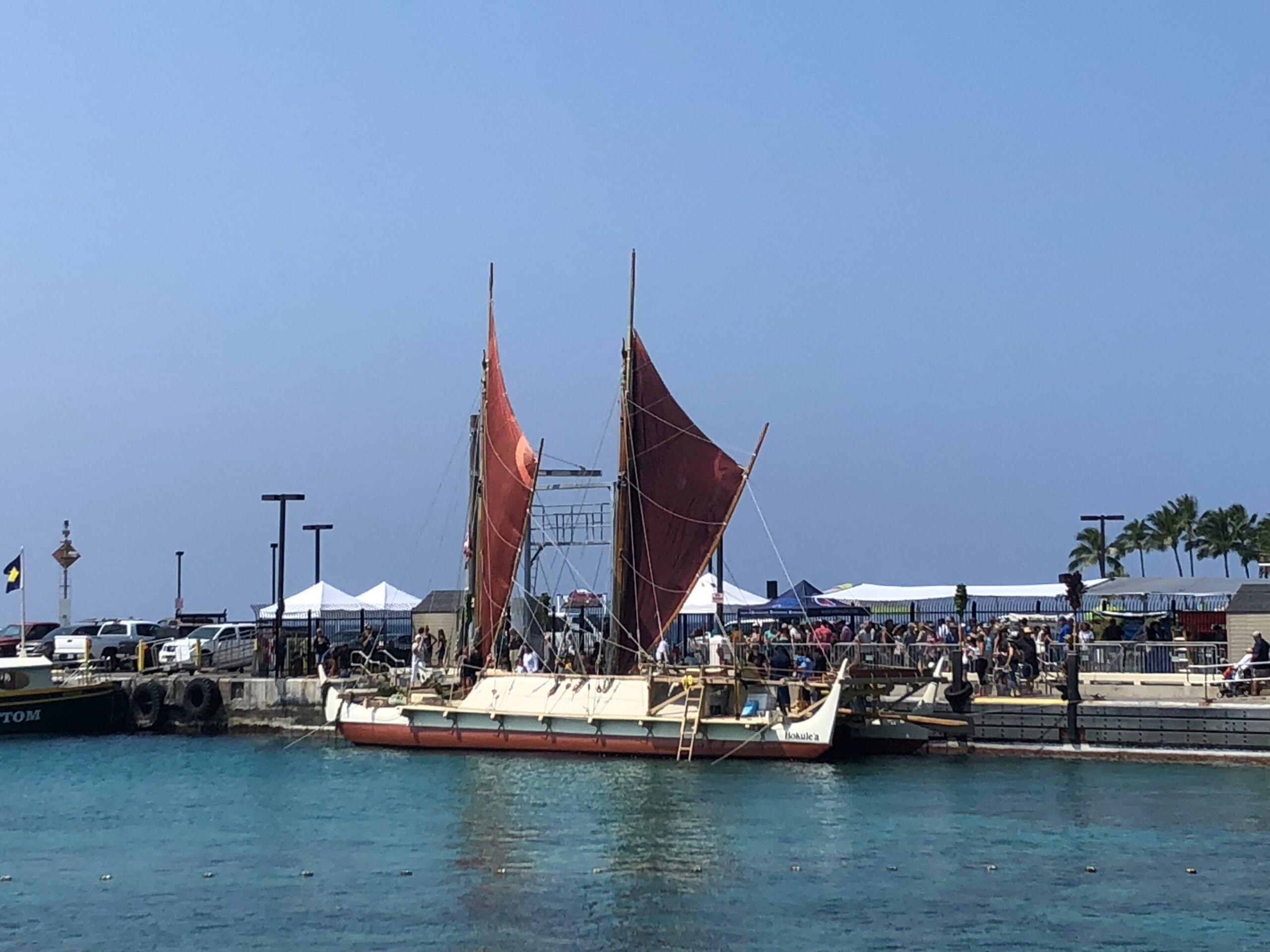
Years later, after moving to Hawai‘i in 2001, I saw Hōkūleʻa in person at Kailua Pier here in Kona in 2018. I still remember that moment quite clearly. And to be honest, my first thought was very simple. It was smaller than I expected. But at the same time, it was immediately obvious that what it carried could not be measured in size.
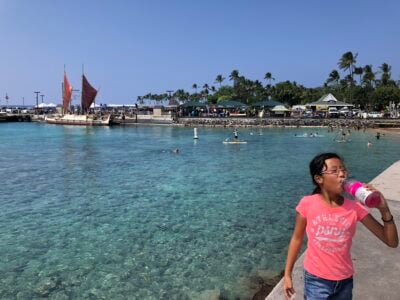
Hokulea in Kailua Bay, Kona
May 1, 1976: The Decision to Begin
When people talk about Hōkūleʻa, the focus is often on its arrival in Tahiti. The celebration, the crowd, the recognition. But in many ways, the more important moment came earlier.
May 1, 1976.
The day the canoe left Hawai‘i. May 1, 2026, will be the 50th year.
Standing on that shoreline, there was no certainty. No GPS, no backup systems, no modern safety net. What existed instead was belief. Belief that ancient Polynesian navigation was not myth, but method. The belief that knowledge once practiced across the Pacific could still be rediscovered and applied.
In the context of Hawai‘i at that time, this departure carried real weight. For years, the dominant narrative suggested that Polynesians had simply drifted across the ocean by accident. Some considered that Hawaiians came from South America. Hōkūleʻa challenged that idea directly. It set out to demonstrate that these journeys were intentional, precise, and deeply understood.
But that truth had to be proven.
And on May 1st, 1976, it had not yet been.
That is what makes that day so meaningful. It was not about success. It was about the willingness to step into the unknown with conviction.
Learning to Read the Ocean Again
As the voyage unfolded, the question was no longer theoretical.
Can this actually be done?
The answer came not all at once, but gradually, through experience. The crew navigated without instruments, relying entirely on the natural world. Stars provided direction. Ocean swells revealed movement. Winds, clouds, and even birds became signals.
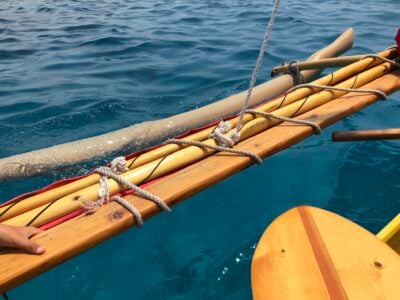
What many would describe as empty ocean was, in reality, structured and readable. But only if you had the knowledge to interpret it.
In that sense, the voyage was not just about reaching Tahiti. It was about relearning how to see.
Knowledge That Lives in the Mind
One of the most fascinating aspects of Hōkūleʻa is that its most important technology cannot be touched or seen.
The Hawaiian star compass exists entirely in the navigator’s mind. It organizes the horizon into directional houses, each anchored by the rising and setting points of specific stars. Over time, this becomes a mental framework that guides movement across vast distances.
And when the sky disappears, the ocean continues to provide information. Subtle swell patterns can be felt through the canoe. Changes in wind and cloud formations offer clues. Birds indicate proximity to land.
This is not simply a set of techniques.
It is a refined relationship with nature, developed over generations.
From Departure to Recognition
When Hōkūleʻa arrived in Tahiti on June 4, 1976, more than 17,000 people gathered on the beach. There was no coordinated campaign behind it. People came because something about the voyage resonated deeply.
It felt less like an arrival and more like a return.
The journey had covered over 2,500 miles, but the cultural distance it bridged was far greater. What began as a question on May 1st became a clear answer.
This was not drift.
This was mastery.
Carrying Knowledge Forward
The voyage did not end in 1976. In many ways, it had just begun.
Nainoa Thompson played a central role in ensuring that this knowledge would not be lost again. His approach was thoughtful and disciplined. He studied the stars using modern tools like the Bishop Museum planetarium, not to replace tradition, but to understand and reconstruct it.
In 1980, he became the first Native Hawaiian in over 600 years to navigate to Tahiti without instruments. That moment confirmed continuity. The knowledge had not disappeared. It had been waiting.
At the same time, this story carries responsibility. The loss of Eddie Aikau in 1978 remains an important part of this history. What followed was not just about preserving knowledge, but honoring those who carried it forward.
A Cultural Reawakening
Hōkūleʻa became more than a canoe the moment it left shore.
It became a catalyst.
Across Hawai‘i and the Pacific, cultural practices began to reemerge with renewed strength. Language, hula, and traditional knowledge systems gained momentum. Connections between Polynesian communities were reestablished.
Each voyage reinforced a shared identity that had always existed, but needed to be seen again.
Today, that legacy continues through Mālama Honua, where the focus has expanded from navigation to stewardship. The idea is simple.
We are all on one canoe.
Why This Still Matters in Kona
Living here on the Big Island, especially in Kona and along the Kohala Coast, you begin to notice something over time.
The beauty of Hawai‘i is immediate. But its meaning is not.
Hōkūleʻa is a reminder that this place is not defined only by scenery or lifestyle. It is grounded in knowledge, resilience, and connection that has developed over generations.
And often, the most important part of any journey is not the arrival.
It is the decision to begin.
Final Thoughts
There is a quote from Nainoa Thompson that has stayed with me:
“If you can’t see the island in your mind, you will never find it in the sea.”
When you think about May 1, 1976, that idea takes on a different weight.
Before the voyage began, the destination existed only in the navigator’s mind. There was no proof yet. Only vision.
Hōkūleʻa carried that vision into the unknown.
And even now, 50 years later, it continues to guide how people think about identity, culture, and what it means to truly find your place in Hawai‘i.
Kai Ioh | KE TEAM HAWAII